Kiyomizu-dera Temple Architecture: Exploring the Traditional Wooden Interlocking Structure
2026年02月17日
Discover the engineering genius of Kiyomizu-dera Temple’s wooden stage. This article explains how the traditional Kake-zukuri style and nail-less Kigumi joinery utilize 139 Zelkova pillars to create a flexible, earthquake-resistant structure. You will understand the secrets behind the durability that has sustained this UNESCO World Heritage site for centuries.
目次
The Architectural Significance of Kiyomizu-dera Temple
Kiyomizu-dera Temple, officially known as Otowa-san Kiyomizu-dera, stands as one of the most celebrated achievements in Japanese architectural history. Located halfway up Mt. Otowa in eastern Kyoto, the temple complex is renowned not only for its spiritual importance as a site of Kannon worship but also for its extraordinary wooden engineering. The Main Hall (Hondo), designated as a National Treasure, exemplifies the sophisticated carpentry techniques that have allowed massive wooden structures to survive for centuries in Japan’s earthquake-prone environment.
A Masterpiece of Edo Period Reconstruction
While the temple was originally founded in 778 by the monk Enchin, the iconic structures seen today are primarily the result of a massive reconstruction effort in the early Edo period. Most of the temple complex, including the Main Hall, was destroyed by fire and subsequently rebuilt in 1633 under the patronage of Tokugawa Iemitsu, the third shogun of the Tokugawa shogunate. This reconstruction represents the pinnacle of traditional Japanese carpentry, blending the aesthetic values of the Heian period with the advanced structural durability developed by Edo-era craftsmen.
The architectural significance lies in the scale and resilience of the Main Hall. Despite being constructed entirely of wood, it has withstood the elements and seismic activity for nearly 400 years. This longevity is a testament to the high level of skill possessed by the miyadaiku (shrine and temple carpenters) of the 17th century, who utilized specific selection methods for timber and structural planning that prioritized flexibility over rigidity.
The “Stage of Kiyomizu” and Kake-zukuri Style
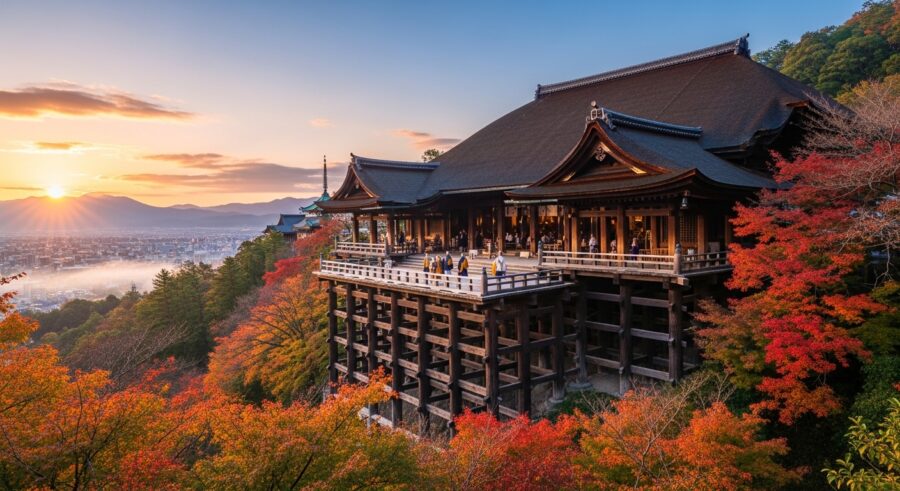
The most distinctive feature of Kiyomizu-dera is its massive wooden stage, known as the “Butai,” which projects out from the Main Hall over a steep cliff. This architectural style is known as Kake-zukuri (suspension construction) or gaijin-zukuri. Historically, this design allowed pilgrims to accommodate the rugged topography of the mountain without altering the natural landscape significantly, reflecting a deep spiritual harmony between the architecture and the sacred mountain environment.
Standing approximately 13 meters (over 40 feet) above the hillside, the stage offers a panoramic view of Kyoto. The phrase “jumping off the stage of Kiyomizu” remains a popular Japanese idiom representing the act of making a bold decision. From an architectural perspective, the stage serves as a large veranda for the Main Hall, providing space for religious ceremonies and the display of traditional performing arts dedicated to the deity Kannon.
Key Architectural Data
The following table summarizes the fundamental architectural data regarding the Main Hall and its construction context, highlighting the specifications that define its historical value.
| Feature | Details |
|---|---|
| Original Founding | 778 AD (Nara Period) |
| Current Construction | 1633 (Early Edo Period) |
| Patron of Reconstruction | Tokugawa Iemitsu (3rd Shogun) |
| Architectural Style | Kake-zukuri (Suspension Style) / Yosemune-zukuri (Main Roof) |
| Main Material | Keyaki (Zelkova) and Hinoki (Japanese Cypress) |
| Stage Height | Approx. 13 meters (equivalent to a 4-story building) |
| Roofing Material | Hiwadabuki (Cypress bark shingles) |
UNESCO World Heritage Recognition
In 1994, Kiyomizu-dera was registered as a UNESCO World Heritage Site as part of the “Historic Monuments of Ancient Kyoto.” The designation recognizes the temple as an outstanding example of Japanese religious architecture that integrates the building with its natural surroundings. The preservation of the Main Hall’s wooden structure is critical not only for Japanese culture but also for the global understanding of traditional timber construction methods.
The temple’s architecture continues to be studied by engineers and architects worldwide. Its ability to support the heavy hiwadabuki (cypress bark) roof and the crowds of visitors upon the projecting stage—without the use of modern metal fasteners in the main structural framework—marks it as a significant reference point in the history of sustainable and resilient construction. For more detailed historical context, you can visit the Kiyomizu-dera Official Website.
Understanding the Traditional Wooden Interlocking Structure
The architectural genius of Kiyomizu-dera Temple lies in its sophisticated wooden joinery, a method that has allowed the massive structure to stand on a steep hillside for centuries. This chapter delves into the traditional techniques that make this possible, focusing on the intricate art of interlocking wood without reliance on modern fasteners.
The Art of Kigumi and Japanese Joinery
At the heart of Kiyomizu-dera’s construction is Kigumi, the traditional Japanese art of wood joinery. This technique involves cutting and shaping timber with extreme precision so that pieces fit together like a complex three-dimensional puzzle. Unlike modern construction which relies heavily on metal connectors, Kigumi depends on the friction and mechanical interlock of the wood itself to maintain structural integrity.
The main hall’s stage is supported by a framework that utilizes specific types of joinery to connect the massive Keyaki (Japanese Zelkova) pillars. The primary method used here involves Nuki (penetrating tie beams) that pass directly through the pillars rather than resting on top of them. This creates a lattice-like structure that is incredibly resistant to lateral forces.
To secure these connections, carpenters employ Kusabi (wedges). These small but crucial wooden pieces are driven into the gaps of the joints to lock the beams in place. If the wood shrinks over time due to age or weather, the wedges can be hammered further in to retighten the structure, a maintenance advantage that ensures longevity.
| Term | Definition | Role in Structure |
|---|---|---|
| Kigumi | Traditional wooden interlocking joinery | The overall system connecting timber without metal fasteners. |
| Nuki | Penetrating tie beam | Passes through pillars to bind them together, providing lateral stability. |
| Kusabi | Wooden wedge | Driven into joints to lock the Nuki and Pillar, allowing for future tightening. |
| Shiguchi | Angled joint | Connects timbers at an angle (e.g., column to beam) to form the structural frame. |
Why the Structure Uses No Nails
A common and celebrated fact about Kiyomizu-dera is that its main structural framework is built without the use of a single metal nail. While traditional Japanese nails (wakugi) may be used in non-structural elements like flooring or roofing, the load-bearing frame relies entirely on wood-to-wood connections. This design choice is driven by engineering necessity rather than mere aesthetic tradition.
The primary reason for avoiding metal nails in the main structure is durability. Iron is susceptible to rust and corrosion, especially in Japan’s humid climate. If metal fasteners were used inside the timber, their corrosion could rot the surrounding wood from the inside out, compromising the building’s lifespan. By using wood alone, the structure ages uniformly, with the Keyaki pillars capable of lasting for hundreds of years.
Furthermore, the nail-less construction provides essential earthquake resistance. Japan is a seismically active region, and rigid metal connections can snap under the immense stress of a tremor. In contrast, the Kigumi joints are flexible; they allow the building to sway and absorb seismic energy. The friction between the wood surfaces acts as a natural damper, and the structure can settle back into position after the shaking stops. This flexibility is a key factor in why Kiyomizu-dera has survived numerous earthquakes throughout its history.
For more details on the temple’s history and preservation, you can visit the Kiyomizu-dera Temple Official Website.
The Engineering Behind the Kake-zukuri Style
The architectural marvel of Kiyomizu-dera lies in its ability to support a massive wooden stage on the steep, uneven slopes of Mount Otowa. This construction method is known as Kake-zukuri (suspension or overhang style), a traditional Japanese technique used to build structures on cliffs or mountainsides. By utilizing a lattice of pillars and beams, the main hall achieves a level floor despite the rugged terrain beneath it. This engineering feat creates the illusion that the temple is floating amongst the trees, a distinctive feature that has attracted pilgrims and visitors for centuries.
The Grid Arrangement of the 139 Pillars
The structural integrity of the Kake-zukuri style relies heavily on the vertical support system. The main hall and stage are supported by a total of 139 massive pillars arranged in a precise grid pattern. These pillars vary in length to accommodate the sharp incline of the cliff, with the tallest pillars reaching approximately 13 meters in height.
The builders selected Keyaki (Japanese Zelkova) for these pillars due to its exceptional hardness, density, and resistance to rot. To ensure the structure could withstand the immense weight of the stage and the crowds it holds, the artisans used timber from Keyaki trees that were roughly 400 years old. In traditional Japanese carpentry, it is believed that wood retains its structural strength for a period equal to the age of the tree when it was felled.
| Structural Component | Material | Details |
|---|---|---|
| Support Pillars | Keyaki (Japanese Zelkova) | 139 pillars arranged in a grid lattice |
| Stage Flooring | Hinoki (Japanese Cypress) | Over 410 boards (approx. 168 tatami mats) |
| Maximum Pillar Height | Keyaki | Approximately 13 meters (4-story equivalent) |
| Foundation Style | Ishiba-date | Pillars rest on natural stone bases without being buried |
Unlike modern foundations where piles are driven deep into the earth, these pillars stand on natural stone bases in a method called Ishiba-date. This technique prevents moisture from the ground from seeping directly into the wood, significantly extending the lifespan of the pillars.
The Role of Penetrating Tie Beams
While the Keyaki pillars provide vertical strength, the horizontal stability of the Kake-zukuri structure is achieved through a system of penetrating tie beams known as Nuki. In this method, horizontal beams pass directly through holes carved into the vertical pillars, rather than simply resting on top of them or being nailed to the side.
This interlocking framework is secured without the use of a single metal nail. Instead, the carpenters utilized the Kigumi (wooden joinery) technique. Once the Nuki beams are threaded through the pillars, they are locked in place using wooden wedges called Kusabi. The friction generated by this joinery creates a rigid yet flexible structure. This “scaffolding-like” appearance is not temporary; it is a deliberate engineering choice that distributes the load evenly across the entire framework.
The use of Nuki and Kusabi allows the timber to expand and contract with seasonal humidity changes without compromising the structure’s integrity. For more details on the temple’s history and preservation, you can refer to the Kiyomizu-dera Official Website.
Durability and Earthquake Resistance
How the Wooden Structure Absorbs Seismic Shocks
The Lifespan of Keyaki and Hinoki Wood
| Wood Type | Primary Application | Key Characteristics | Maintenance Cycle |
|---|---|---|---|
| Keyaki (Zelkova) | Main structural pillars (139 columns) | High density, extreme hardness, load-bearing strength | Structural lifespan of ~800 years |
| Hinoki (Cypress) | Stage flooring (“Butai-ita”), Roof bark | Water resistance, rot resistance, straight grain | Replaced every 30–40 years |
Conclusion
The architectural mastery of Kiyomizu-dera Temple stands as a testament to the ingenuity of traditional Japanese craftsmanship. Rebuilt in 1633 under the orders of Tokugawa Iemitsu, the Main Hall and its iconic stage have withstood centuries of natural elements and seismic activity. This endurance is largely attributed to the sophisticated Kake-zukuri (suspension) style and the nail-less Kigumi interlocking joinery. By harmonizing with the steep topography of Mount Otowa rather than resisting it, the structure exemplifies a philosophy of resilience and coexistence with nature that continues to inspire modern engineering.
The Engineering Marvel of the Wooden Stage
The most defining feature of Kiyomizu-dera is its massive wooden stage, which projects 13 meters outward from the Main Hall. This structure is supported by 139 colossal pillars carved from centuries-old Keyaki (Japanese Zelkova). These pillars are arranged in a grid and connected by penetrating tie beams known as nuki, creating a flexible framework that absorbs and dissipates the energy from earthquakes.
Unlike modern rigid constructions, the traditional Kigumi technique relies on friction and the natural expansion of wood to hold joints securely in place. The absence of metal nails in the structural frame prevents corrosion and allows the timber to move slightly without snapping, a crucial factor in the temple’s longevity. This architectural feat has earned Kiyomizu-dera its status as a UNESCO World Heritage Site and the origin of the Japanese proverb “to jump off the stage of Kiyomizu,” symbolizing a bold decision.
| Feature | Material / Technique | Structural Role |
|---|---|---|
| Support Pillars | 139 Keyaki (Zelkova) logs | Provide vertical load-bearing support on the steep cliffside. |
| Joinery System | Kigumi (Interlocking wood) | Connects timbers without nails, allowing flexibility during tremors. |
| Flooring | 410 Hinoki (Cypress) boards | Creates a durable, weather-resistant surface for the stage. |
| Foundation Style | Kake-zukuri (Overhang style) | Adapts the building to the irregular terrain of the mountain. |
Sustainability and Future Preservation
The preservation of Kiyomizu-dera extends beyond mere maintenance; it involves a forward-thinking approach to resource management. The Keyaki pillars and Hinoki flooring are organic materials with a finite lifespan, estimated to last up to 800 years with proper care. To ensure the temple can be restored in the distant future, forestry projects are currently underway to grow the massive trees required for the next major reconstruction, centuries from now.
This cyclical view of construction—where the planting of trees today guarantees the survival of architecture tomorrow—reflects the deep spiritual and practical connection between the temple and its environment. As visitors stand upon the stage and gaze out over Kyoto, they are supported not just by wood and joinery, but by a legacy of traditional wisdom that bridges the past with the future.