Kinkaku-ji’s Wooden Architecture and the Changing Scenery of the Four Seasons
2026年02月10日
Explore the architectural fusion of aristocratic, samurai, and Zen styles at Kinkaku-ji. This guide reveals how the Golden Pavilion’s scenery shifts from spring blossoms to winter snow, ensuring you find the perfect time to visit Kyoto’s iconic UNESCO World Heritage site.
目次
- 1 The Allure of Rokuon-ji: Where Architecture Meets Nature
- 2 The Three-Story Wooden Architecture: A Blend of Styles
- 3 Seasonal Scenery: The Changing Faces of Kinkaku-ji
- 4 Exploring the Gardens and Grounds
- 5 Visitor Guide: Access and Best Times to Visit
- 5.1 Getting to Kinkaku-ji from Kyoto Station
- 5.2 By Kyoto City Bus (Direct Route)
- 5.3 By Subway and Bus (Traffic-Avoidance Route)
- 5.4 By Taxi
- 5.5 Opening Hours and Admission Fees
- 5.6 Recommended Times for Photography
- 5.7 The Morning Reflection (9:00 AM – 10:30 AM)
- 5.8 The Golden Sunset (3:00 PM – 4:30 PM)
- 5.9 Seasonal Considerations
- 6 Nearby Attractions on the Kinukake-no-michi
- 7 Conclusion
The Allure of Rokuon-ji: Where Architecture Meets Nature
Nestled amidst the serene landscapes of northern Kyoto, the temple popularly known as Kinkaku-ji (Golden Pavilion) stands as one of Japan’s most iconic and visually striking landmarks. While the dazzling gold-leaf exterior captures the imagination of visitors worldwide, the site is officially designated as Rokuon-ji (Deer Garden Temple). It functions as a prominent Zen Buddhist temple of the Shokoku-ji branch of the Rinzai sect.
The allure of Rokuon-ji stems from a rich tapestry of history dating back to the late 14th century and an architectural brilliance that seamlessly blends different styles. It is a masterpiece where the constructed environment and the natural world are not separate entities but are integrated to create a representation of the Pure Land (Buddhist paradise) on earth.
Overview of the Golden Pavilion
The centerpiece of the temple complex is the Golden Pavilion (Kinkaku) itself, a three-story edifice renowned for its top two floors being entirely covered in brilliant gold leaf. This radiant exterior creates a breathtaking spectacle, especially when illuminated by sunlight or mirrored perfectly on the surface of the Kyoko-chi Pond (Mirror Pond) that it overlooks.
The structure was originally built as a retirement villa (Kitayama-dono) for Ashikaga Yoshimitsu, the third shogun of the Muromachi period. It was transformed into a Zen temple after his death in 1408, fulfilling his final wishes. The pavilion evokes the opulent Kitayama culture, which was characterized by a unique fusion of courtly aristocratic elegance and samurai aesthetics, heavily influenced by Zen Buddhism and Ming-dynasty Chinese culture.
Although the original structure survived the Onin War, it was tragically destroyed by arson in 1950. The current structure is a faithful reconstruction completed in 1955, with extensive re-gilding work finished in 1987 to ensure the pavilion continues to shine for generations. To understand the scope and status of this historic site, the following table outlines the essential details regarding its location and affiliation.
| Feature | Detail |
|---|---|
| Official Name | Rokuon-ji (鹿苑寺) |
| Popular Name | Kinkaku-ji (金閣寺), Golden Pavilion |
| Location | Kita-ku, Kyoto, Japan |
| Affiliation | Rinzai Zen Buddhism, Shokoku-ji branch |
| Original Purpose | Retirement villa for Shogun Ashikaga Yoshimitsu |
| Current Structure | Reconstructed in 1955 (following the 1950 arson) |
For the most accurate and up-to-date information regarding temple events and religious services, visitors are encouraged to consult the official website of Kinkaku-ji.
UNESCO World Heritage Significance
In December 1994, Kinkaku-ji was inscribed as a UNESCO World Heritage Site as part of the “Historic Monuments of Ancient Kyoto.” Its designation is not merely due to its age, but because it represents a masterpiece of Japanese garden design and architecture that illustrates a significant stage in human history.
The temple is recognized for its “Outstanding Universal Value,” particularly for how its architecture harmonizes with the surrounding landscape. The garden is a prime example of the chisen-kaiyu-shiki (stroll garden with a central pond) style. The integration of the Golden Pavilion with the Kyoko-chi Pond demonstrates the Muromachi period’s high artistic achievement in blending structures with nature.
Even though the main pavilion is a reconstruction, UNESCO recognizes the site’s integrity and the continuity of its religious and cultural function since the 14th century. The site embodies the successful amalgamation of court noble refinement, samurai strength, and Chinese Zen influences, which dictated Japanese aesthetics for centuries to follow. For further details on the cultural heritage of this site, you can refer to the UNESCO World Heritage Centre.
The Three-Story Wooden Architecture: A Blend of Styles
The Golden Pavilion, or Kinkaku, serves as the shariden (reliquary hall) of Rokuon-ji Temple and stands as one of the most celebrated examples of Muromachi period architecture. Its enduring fame stems not only from its opulent exterior but from the unique structural harmony achieved by stacking three distinct architectural styles atop one another. This design reflects the vision of Ashikaga Yoshimitsu, who sought to blend the aesthetics of the court aristocracy, the samurai warrior class, and the Zen Buddhist priesthood into a unified expression of Kitayama culture.
First Floor: The Shinden-zukuri Style of the Aristocracy
The ground floor is named the Hossui-in (Chamber of Dharma Waters). Unlike the dazzling upper stories, this floor is not covered in gold leaf. Instead, it features natural, unpainted wood and white plaster walls, grounding the structure in earthly simplicity.
Architecturally, it follows the Shinden-zukuri style, which was prevalent in the residential palaces of the Heian period aristocracy (11th century). Key characteristics include open verandas and the use of shitomido (retractable wooden shutters), designed to blur the boundary between the interior space and the surrounding garden. The open structure allows the pavilion to harmonize with the Kyoko-chi Pond, creating a seamless transition from the building to nature. Inside, it houses statues of Shaka Nyorai (the historical Buddha) and Ashikaga Yoshimitsu himself.
Second Floor: The Buke-zukuri Style of the Samurai
The second story is known as the Choon-do (Tower of Sound Waves). This floor represents the Buke-zukuri style, which characterizes the residences of the samurai warrior class during the Kamakura period. In contrast to the open, airy feel of the first floor, this level is more enclosed, reflecting the disciplined lifestyle of the warrior.
The exterior is entirely covered in brilliant gold leaf, marking the transition from the earthly realm to the spiritual. This floor functions as a Buddha Hall (Butsuma) and enshrines a seated statue of the Kannon Bodhisattva, surrounded by the Four Heavenly Kings (Shitenno), who serve as guardians. The blending of the warrior style with the aristocratic base symbolizes the rising power of the samurai class under the Ashikaga shogunate.
Third Floor: The Zenshu-butsuden Style of Zen
The uppermost floor is called the Kukkyo-cho (Cupola of the Ultimate). It is built in the Zenshu-butsuden-zukuri style, which is derived from Chinese Zen architecture of the Ming Dynasty. This style is distinctively characterized by its bell-shaped or cusped windows, known as katomado.
Both the interior and exterior of this floor are gilded, reinforcing the concept of a “Golden Pavilion.” As the true reliquary of the temple, it houses the sacred ashes of the Buddha (Busshari). The placement of the Zen style at the very pinnacle of the structure—above the styles of the aristocracy and the samurai—is widely interpreted as an expression of Ashikaga Yoshimitsu’s belief in the supremacy of Zen Buddhism and his desire to restructure the social hierarchy with Zen at the summit.
| Floor | Japanese Name | Architectural Style | Social Representation |
|---|---|---|---|
| 1st Floor | Hossui-in | Shinden-zukuri (Palace Style) | Imperial Aristocracy |
| 2nd Floor | Choon-do | Buke-zukuri (Warrior Style) | Samurai Class |
| 3rd Floor | Kukkyo-cho | Zenshu-butsuden (Zen Style) | Zen Priesthood |
Symbolism of the Gold Leaf and the Phoenix
The visual impact of Kinkaku-ji is defined by the luminous gold leaf that covers the upper two stories. This application is not merely decorative; it holds profound spiritual meaning in Pure Land Buddhism. Gold is considered a metal that does not tarnish or corrode, symbolizing purity, the immutable nature of the Buddha’s wisdom, and the Western Paradise (Pure Land). The reflection of the golden pavilion in the Kyoko-chi Pond is intended to create an earthly representation of this Buddhist paradise.
During the major restoration in 1987, the gold leaf was reapplied using a traditional lacquer adhesive method. The leaf used is approximately five times thicker than standard gold leaf to ensure durability against Kyoto’s weather. For more on the preservation of such cultural properties, you can refer to the UNESCO World Heritage Centre.
Crowning the shingled roof is a bronze statue of a Phoenix (Ho-o or Fenghuang). In East Asian mythology, the phoenix is an auspicious bird associated with the imperial household, symbolizing virtue, harmony, and rebirth. It is said to appear only during times of peace and benevolent rule. The phoenix faces south, watching over the temple grounds. Interestingly, the original phoenix statue was removed for repair prior to the 1950 arson incident, allowing it to survive the fire that destroyed the rest of the pavilion. The current ornament is a faithful reproduction that completes the building’s ascent from the earthly to the celestial. For official details on the temple’s history and architecture, please visit the official Kinkaku-ji website.
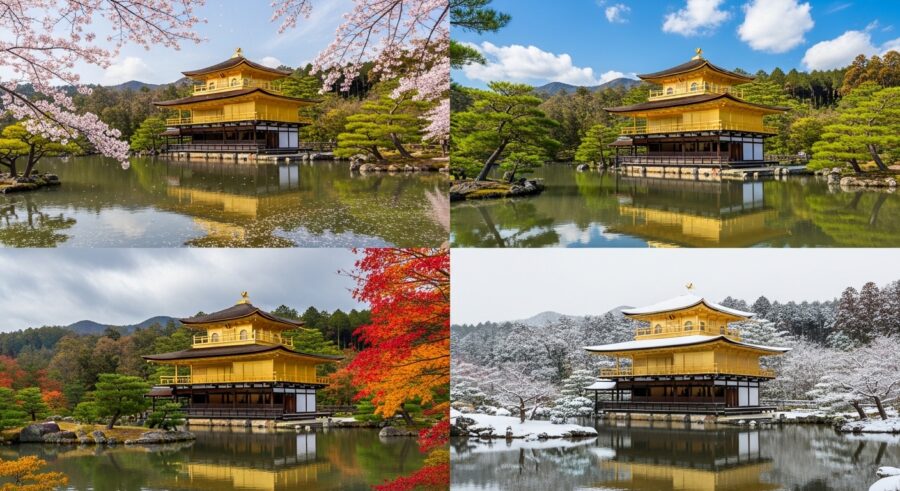
Seasonal Scenery: The Changing Faces of Kinkaku-ji
The enduring appeal of Kinkaku-ji lies not only in its architectural brilliance but in its dynamic relationship with the surrounding nature. As a masterpiece of the chisen-kaiyu-shiki (stroll garden with a central pond) style, the temple grounds are designed to evolve visually throughout the year. The golden exterior of the pavilion acts as a canvas, reflecting the shifting colors of the seasons and the waters of the Kyoko-chi Pond (Mirror Pond), ensuring that no two visits offer exactly the same experience.
Spring: Cherry Blossoms and Fresh Greenery
While Kinkaku-ji is not as densely planted with cherry trees as some of Kyoto’s other famous spots, the arrival of spring brings a subtle and elegant beauty to the grounds. In early April, the few Somei Yoshino and weeping cherry trees located near the entrance and around the pond bloom, adding delicate splashes of pale pink against the structured landscape.
However, the true highlight of spring at Rokuon-ji is the emergence of fresh greenery, known as shinryoku. As the season progresses into May, the maples and pines surrounding the pavilion burst into a vibrant, translucent green. This fresh foliage frames the Golden Pavilion, creating a crisp contrast where the brightness of the leaves rivals the brilliance of the gold leaf. The air is often clearest during this season, allowing for sharp, high-definition reflections on the water’s surface.
Summer: Vibrant Greens and the Mirror Pond
Summer in Kyoto is characterized by intense sunlight and lush vegetation. During these months, the Golden Pavilion shines with its greatest intensity. The high angle of the sun illuminates the gold leaf, causing it to glitter against the deep, dark greens of the fully matured moss and foliage. This is the season when the concept of the “Pure Land” is most visually palpable, as the radiant structure seems to emit its own light.
The Kyoko-chi Pond plays a pivotal role in summer. The abundance of sunlight enhances the clarity of the reflection, creating the famous “inverted Golden Pavilion” on the water. Additionally, the official Kinkaku-ji grounds feature blooming irises and lotus plants in specific areas of the pond, adding touches of purple and white to the verdant landscape. Visitors seeking respite from the heat often find the shaded paths leading toward the Sekkatei Teahouse particularly refreshing during this season.
Autumn: The Contrast of Red Maples and Gold
Autumn is widely considered the most photogenic season at Kinkaku-ji. From mid-November to early December, the numerous maple trees planted throughout the garden transform into fiery shades of crimson, orange, and gold. This phenomenon, known as koyo, creates a dramatic backdrop that complements the warm tones of the pavilion’s gold leaf.
The visual harmony during autumn is achieved through the landscape design technique of shakkei (borrowed scenery). The red foliage of the garden merges seamlessly with the forested slopes of Mount Kinugasa in the background, making the temple grounds feel expansive. The path leading towards the exit becomes a tunnel of red maples, offering visitors a final, immersive experience of Kyoto’s seasonal beauty. Due to the angle of the sun, late afternoon in autumn casts a warm glow that turns the pavilion into a deep amber hue.
Winter: The Breathtaking “Snow Makeup”
Perhaps the most coveted view of Kinkaku-ji is the “Snow Makeup” (Yukigesho). Snow accumulation in Kyoto is relatively rare, often occurring only a few times a year between January and February. When it does snow, the landscape undergoes a profound transformation into a monochrome world of white and black, from which the Golden Pavilion emerges in stark, brilliant contrast.
The white snow capping the shingled roof and resting on the branches of the “Land Boat Pine” creates a scene of profound silence and serenity, reminiscent of a traditional ink wash painting. If the temperature drops sufficiently, the edges of the Kyoko-chi Pond may partially freeze, altering the texture of the reflection. Because the snow often melts by the afternoon, photographers and locals rush to the temple early in the morning to witness this fleeting spectacle.
To help plan your visit based on these seasonal transformations, the table below summarizes the key features and peak timing for each season.
| Season | Peak Timing | Key Visual Features | Photography Tip |
|---|---|---|---|
| Spring | Early April (Blossoms) May (Greenery) |
Subtle cherry blossoms, vibrant fresh green maples (shinryoku). | Capture the contrast between the pale pink petals and the gold leaf. |
| Summer | July – August | Intense sunlight, deep green foliage, clear reflections. | Use a polarizing filter to manage the glare from the gold and water. |
| Autumn | Late Nov – Early Dec | Fiery red maples, warm sunlight, borrowed scenery of Mt. Kinugasa. | Late afternoon light enhances the golden warmth against the red leaves. |
| Winter | Jan – Feb (Unpredictable) | White snow on the roof and garden, stark contrast with gold. | Arrive at 9:00 AM sharp; snow often melts by midday. |
For real-time updates on seasonal conditions, particularly during the autumn foliage season or snowy days, checking the Kyoto City Official Travel Guide is recommended before departing for the temple.
Exploring the Gardens and Grounds
Kyoko-chi Pond and the Art of Reflection
Traditional Landscape Design and Borrowed Scenery
Key Garden Features: Land Boat Pine and Dragon Gate Waterfall
| Feature Name | Description | Cultural & Symbolic Significance |
|---|---|---|
| Rikushu-no-Matsu (Land Boat Pine) |
A pine tree trained into the shape of a boat, located near the Hojo (Head Priest’s quarters). | Symbolizes the vessel transporting souls to the Pure Land. It is considered one of the three great pines of Kyoto. |
| Ryumonbaku (Dragon Gate Waterfall) |
A 2.3-meter high waterfall with a “Carp Stone” placed beneath the flow. | Represents the “Carp leaping the Dragon Gate,” symbolizing success, perseverance, and spiritual ascension in Zen Buddhism. |
| Anmintaku Pond | A small, serene pond located on higher ground behind the pavilion, featuring a stone pagoda. | Known as a pond that never dries up. The pagoda (Hakuja-no-tsuka) is dedicated to the White Snake, a guardian deity of water and good fortune. |
| Sekkatei Teahouse | A rustic tea house perched on the hill, added during the Edo period. | Its name means “Place of Evening Beauty,” suggesting the ideal vantage point to view the Golden Pavilion bathed in the setting sun. |
Visitor Guide: Access and Best Times to Visit
Planning a visit to Rokuon-ji, widely known as Kinkaku-ji, requires careful consideration of transportation and timing to ensure a seamless experience. Located in northern Kyoto, the temple is somewhat removed from the city center, making route planning essential. Furthermore, understanding the interplay of light on the Golden Pavilion is key to capturing the perfect photograph of this UNESCO World Heritage Site.
Getting to Kinkaku-ji from Kyoto Station
Kyoto Station serves as the primary transport hub for visitors. While there is no train station immediately adjacent to Kinkaku-ji, the site is well-connected by Kyoto City Bus and a combination of subway and bus routes.
By Kyoto City Bus (Direct Route)
The most direct method for most tourists is the bus. From the main bus terminal at the Karasuma Exit (North side) of Kyoto Station, visitors can board specific lines that drop off passengers steps away from the temple entrance.
- Bus Numbers: Route #101 or #205.
- Boarding Area: Typically stands B2 or B3.
- Travel Time: Approximately 40 minutes. Please note that during cherry blossom season (spring) and autumn foliage season, traffic congestion can significantly extend this time.
- Fare: A flat rate of 230 JPY applies within the designated city zone.
By Subway and Bus (Traffic-Avoidance Route)
To bypass surface traffic in the city center, utilizing the subway for the first leg of the journey is often more reliable, particularly during peak tourist seasons.
- Take the Karasuma Subway Line from Kyoto Station to Kitaoji Station (approx. 15 minutes).
- Exit via the gates leading to the Kitaoji Bus Terminal.
- Transfer to City Bus #204 or #205.
- Alight at the Kinkakuji-michi bus stop (approx. 10 minutes).
By Taxi
For those prioritizing comfort or traveling in small groups, a taxi offers a direct and stress-free option. The ride from Kyoto Station takes approximately 30 minutes, with fares generally ranging between 3,500 and 4,000 JPY. Taxis can drop passengers closer to the main gate than the bus stops.
For real-time transit updates and route planning, the Kyoto City Official Travel Guide is a valuable resource.
Opening Hours and Admission Fees
Kinkaku-ji is renowned for its accessibility, remaining open to the public every day of the year. However, visitors must be prepared with cash, as electronic payment methods are generally not accepted at the ticket booth.
| Category | Details |
|---|---|
| Opening Hours | 9:00 AM – 5:00 PM |
| Closing Days | None (Open 365 days a year) |
| General Admission (Adults) | 500 JPY (High school students and older) |
| Reduced Admission (Children) | 300 JPY (Elementary and Junior High students) |
| Payment Method | Cash Only (Credit cards and IC cards are not accepted) |
For the most accurate information regarding religious ceremonies or temporary changes, please verify with the official Kinkaku-ji website before your visit.
Recommended Times for Photography
The visual impact of the Golden Pavilion changes drastically depending on the position of the sun. To capture the iconic image of the temple, timing is crucial.
The Morning Reflection (9:00 AM – 10:30 AM)
Arriving right when the gates open at 9:00 AM is widely considered the best strategy for photographers. During the morning, the sun rises from the east, illuminating the front of the Golden Pavilion directly. This front-lighting creates a brilliant, vivid gold color.
Additionally, the wind is often calmer in the early morning. A still surface on the Kyoko-chi Pond (Mirror Pond) is essential for capturing the flawless “inverted Kinkaku” reflection. As the day progresses, breezes often pick up, rippling the water and disturbing the mirror effect.
The Golden Sunset (3:00 PM – 4:30 PM)
Late afternoon offers a different, yet equally stunning atmosphere. As the sun begins to lower in the west, the light becomes warmer and softer. The gold leaf reflects this ambient light, giving the structure a deep, glowing aura. This time slot is also advantageous for avoiding the peak midday crowds, as large tour groups often depart by late afternoon.
Seasonal Considerations
While the time of day matters, the season also dictates the photographic scenery:
- Winter: If you are fortunate enough to visit after a snowfall, the “Snow Makeup” (Yukigesho) is best viewed immediately at opening (9:00 AM) before the sun melts the snow on the roof.
- Autumn: In late November, the red maples surrounding the pond are backlit by the afternoon sun, creating a fiery contrast with the gold.
Nearby Attractions on the Kinukake-no-michi
While the Golden Pavilion is often the primary destination for visitors to northwest Kyoto, it is merely the starting point of a historically rich route known as the Kinukake-no-michi (Road of Silk Hanging). This scenic road spans approximately 2.5 kilometers and connects three distinct UNESCO World Heritage Sites: Kinkaku-ji, Ryoan-ji, and Ninnaji. The name derives from a legend involving Emperor Uda, who ordered Mount Kinugasa to be draped in white silk so he could enjoy a snowy landscape even in the height of summer.
Exploring this route allows travelers to experience a profound narrative of Japanese history, transitioning from the shogunate’s extravagance at Kinkaku-ji to the austere Zen philosophy of Ryoan-ji, and finally to the elegant imperial heritage of Ninnaji. The path is well-suited for a leisurely walk or a short bus ride, offering a comprehensive tour of Kyoto’s diverse architectural and landscape traditions.
Ryoan-ji Temple and the Rock Garden
Located approximately 1.5 kilometers west of Kinkaku-ji, Ryoan-ji Temple offers a striking aesthetic contrast to the golden opulence of its neighbor. A pleasant 20-minute walk or a short ride on City Bus #59 connects these two iconic sites. Ryoan-ji is world-renowned for its karesansui (dry landscape) rock garden, which is widely considered the finest surviving example of this abstract style of Zen design.
The garden consists of a rectangular plot of white pebbles measuring 25 meters by 10 meters, surrounded by low earthen walls made of clay boiled in oil. Within this space, 15 stones of varying sizes are arranged in five groups. The layout is designed with a unique visual paradox: from any vantage point on the viewing veranda, at least one of the stones is always hidden from sight. This design invites deep contemplation on the nature of perception, completeness, and the Zen concept of “wabi-sabi” (beauty in imperfection).
Beyond the rock garden, the temple grounds feature the extensive Kyoyochi Pond, a remnant of the aristocratic estate that predated the temple. This area offers beautiful walking paths and seasonal flora, providing a soft, natural counterpoint to the rigid austerity of the rock garden.
Ninnaji Temple and Omuro Cherry Trees
Continuing further west along the Kinukake-no-michi lies Ninnaji Temple, the final UNESCO site on this route. Founded in 888 AD, Ninnaji is classified as a Monzeki temple, indicating that it was traditionally headed by a member of the Imperial family. This lineage is evident in the elegant Goten Palace, which features covered corridors and architectural styles reminiscent of the Kyoto Imperial Palace, offering a rare glimpse into the lifestyle of court nobles.
Ninnaji is particularly famous for its Omuro Sakura, a grove of late-blooming cherry trees. Unlike the more common Somei Yoshino variety found elsewhere in Kyoto, Omuro cherry trees are shorter in stature, allowing visitors to walk amidst the blossoms rather than just looking up at them. These trees typically bloom in mid-April, extending the cherry blossom viewing season in Kyoto. The temple complex also boasts a majestic five-story pagoda that dominates the skyline and the Kondo (Main Hall), which is a designated National Treasure.
To help plan your itinerary along the Kinukake-no-michi, the table below outlines the key details for these interconnected sites.
| Attraction | Primary Feature | Access from Previous Site | Recommended Duration |
|---|---|---|---|
| Ryoan-ji Temple | Zen Rock Garden (Karesansui) | ~20 min walk or 5 min bus (Bus #59) from Kinkaku-ji | 45–60 minutes |
| Ninnaji Temple | Omuro Cherry Trees & Goten Palace | ~10 min walk or 3 min bus (Bus #59) from Ryoan-ji | 60–90 minutes |
For those utilizing public transport, Kyoto City Bus #59 provides a convenient link between Kinkaku-ji, Ryoan-ji, and Ninnaji, making it easy to visit all three in a single half-day trip. This triad of temples provides a perfect cross-section of Kyoto’s cultural evolution, making the Kinukake-no-michi an essential addition to any Kinkaku-ji visit.
Conclusion
Kinkaku-ji, officially recognized as Rokuon-ji, stands as a definitive symbol of Kyoto’s enduring legacy and the artistic zenith of the Muromachi period. As a designated UNESCO World Heritage Site, it offers more than just a visual spectacle; it presents a profound narrative of Japanese history, where the spiritual world of Zen Buddhism harmonizes with the earthly authority of the shogunate. The temple’s enduring appeal lies in its unique ability to blend diverse architectural styles with a landscape that transforms dramatically throughout the year, offering a distinct experience to visitors in every season.
The Harmony of Wooden Architecture and Gold
The Golden Pavilion is a rare architectural masterpiece that physically embodies the cultural fusion of the Kitayama culture. By stacking three distinct styles—the aristocratic Shinden-zukuri, the samurai Buke-zukuri, and the spiritual Zenshu-butsuden—the structure narrates the shifting power dynamics of 14th-century Japan. The application of brilliant gold leaf on the upper floors serves not merely as decoration but as a symbolic representation of the Pure Land paradise, remaining immutable against the passage of time. This architectural hierarchy, crowned by the bronze phoenix, creates a seamless transition from the earthly realm to the celestial, grounded by the natural timber of the first floor and ascending to the spiritual brilliance of the zenith.
Seasonal Scenery: A Year-Round Canvas
One of Kinkaku-ji’s most compelling attributes is its interaction with the four seasons, ensuring that the “Golden Pavilion” presents a different face depending on when it is viewed. The surrounding stroll garden and the Kyoko-chi (Mirror Pond) act as a living canvas that complements the golden structure.
- Spring: The grounds are softened by the subtle pinks of cherry blossoms and the emergence of fresh verdure, creating a gentle contrast with the gold.
- Summer: Under the intense sunlight, the pavilion shines brilliantly against deep green foliage, with the reflection in the Mirror Pond appearing most vivid.
- Autumn: The temple is framed by fiery red maples, creating a breathtaking palette of gold and crimson that is considered by many to be the peak of its beauty.
- Winter: On rare occasions, the “Snow Makeup” (Yukigesho) covers the roof and garden in white, offering a stark, monochrome beauty where the gold glows quietly amidst the snow.
Summary of the Kinkaku-ji Experience
To assist in planning a visit that captures the essence of this historic site, the following table summarizes the key elements that define the Rokuon-ji experience.
| Category | Key Feature | Significance |
|---|---|---|
| Architecture | Three-Story Hybrid Style | Unifies Court, Samurai, and Zen aesthetics; symbolizes the political and spiritual vision of Ashikaga Yoshimitsu. |
| Landscape | Kyoko-chi (Mirror Pond) | Reflects the pavilion to create an “Inverted Golden Pavilion,” symbolizing the union of heaven and earth. |
| Cultural Status | UNESCO World Heritage | Recognized as part of the “Historic Monuments of Ancient Kyoto” for its outstanding universal value and landscape design. |
| Seasonal Highlight | Changing Scenery | From the “Snow Makeup” of winter to the red maples of autumn, the garden ensures a unique view year-round. |
A visit to Kinkaku-ji is a journey through the heart of Japanese aesthetics. Whether observing the meticulous details of the wooden architecture or pausing to admire the reflection of the pavilion in the stillness of the pond, visitors are invited to step back into the Muromachi period. As a cornerstone of the Kinukake-no-michi route, it serves as the perfect starting point for exploring the rich cultural tapestry of northwest Kyoto.
For the most accurate information regarding visiting hours and special religious events, please refer to the Official Kinkaku-ji Website. For broader travel planning within the city, the Kyoto City Official Travel Guide offers extensive resources. To understand the global significance of this site, visit the UNESCO World Heritage Centre.