Top Recommended Sightseeing Spots for Breathtaking Japan Winter Scenery
2025年12月15日
Japan is globally renowned for its spring cherry blossoms, but the country’s winter scenery offers a serene and dramatic beauty that is equally compelling for international travelers. From the world-class powder snow of Hokkaido to the illuminated traditional farmhouses of Shirakawa-go, the colder months transform the archipelago into an ethereal wonderland distinct from any other season. In this comprehensive guide, we explore the top recommended sightseeing spots that define the Japanese winter experience, including the vibrant Sapporo Snow Festival, the mystical “Snow Monsters” of Zao, and the quiet elegance of Kyoto’s temples under a blanket of white. Readers will gain a clear understanding of the best destinations across the Tohoku, Chubu, and Kansai regions, along with practical insights on how to navigate these snowy landscapes. By the end of this article, you will recognize that the true value of visiting Japan in winter lies in the unique harmony of breathtaking natural vistas, warming traditional onsen culture, and historical architecture, providing a travel experience that is both visually stunning and deeply relaxing.
目次
- 1 Why Japan Winter Scenery Is a Must-See Experience
- 2 Hokkaido The Ultimate Winter Wonderland
- 3 Tohoku Region Deep Snow and Traditional Vibes
- 4 Chubu Region The Japanese Alps and Historic Villages
- 5 Kansai and Surroundings Iconic Temples in Snow
- 6 Practical Tips for Visiting Recommended Sightseeing Spots
- 7 Conclusion
Why Japan Winter Scenery Is a Must-See Experience
Japan’s winter scenery offers a visual and sensory experience unlike anywhere else in the world. While the country is globally renowned for its spring cherry blossoms, the winter months (typically December to February) transform the archipelago into a landscape of stark contrasts and ethereal beauty. The combination of unique geographical factors and rich cultural traditions creates a winter wonderland that appeals to photographers, nature lovers, and culture seekers alike.
The Phenomenon of “Japow” and “Yukiguni”
One of the primary reasons to visit Japan in winter is the incredible quality and volume of the snow, often referred to by enthusiasts as “Japow” (Japan Powder). Cold winds blowing from Siberia across the Sea of Japan pick up moisture and dump heavy blankets of dry, powdery snow along the western coast and mountainous regions. This creates the Yukiguni (Snow Country), where snow accumulation can reach several meters, softening the landscape into rounded, dreamlike shapes. This deep snow creates a profound silence and purity in the scenery, turning ordinary villages and forests into ink-wash painting landscapes.
The Unique Culture of Yukimi Onsen
Perhaps the most iconic way to immerse oneself in the winter scenery is through the tradition of Yukimi Onsen, or “snow-viewing hot springs.” Unlike many other winter destinations where the cold is something to be escaped indoors, Japan invites visitors to embrace the chill from the warmth of a geothermal bath. The striking contrast between the freezing air, the pristine white snow, and the steaming hot water provides a meditative experience that is central to Japanese wellness culture. This interplay of fire and ice is a quintessential element of the Japanese winter aesthetic.
Illuminations and Crystal Clear Vistas
Japanese winter is not solely about snow; it is also a season of light and clarity. Cities and parks across the country host elaborate winter illumination events that run from late autumn through the winter. These displays often use millions of LED lights to create dazzling nightscapes that rival the snowy mountains in beauty. Furthermore, the low humidity and crisp winter air improve visibility significantly, allowing for breathtaking views of iconic landmarks like Mount Fuji, which is often obscured by haze during the warmer months.
| Feature | Description | Why It Is Special |
|---|---|---|
| Snow Quality | Ultra-light, dry powder snow known as “Japow.” | Creates soft, billowy landscapes and offers world-class conditions for winter sports enthusiasts. |
| Visual Contrast | Vibrant architecture against white snow. | Red shrine gates (Torii) and black castle roofs stand out vividly against the white background, creating photogenic scenes. |
| Atmosphere | Quietude mixed with festive light. | The hush of deep snow in rural areas contrasts with the vibrant winter illuminations in urban centers. |
Hokkaido The Ultimate Winter Wonderland
Hokkaido is Japan’s northernmost island and the undisputed king of winter travel. Famous worldwide for its high-quality powder snow, known affectionately as “Japow,” the region transforms into a white canvas of dramatic landscapes and vibrant festivals from January through March. While skiers flock to Niseko and Rusutsu, sightseers are drawn to the island’s unique cultural events and natural phenomena that can only be experienced in this subarctic climate. To truly appreciate the Japanese winter, a visit to Hokkaido is essential.
Sapporo Snow Festival
The Sapporo Snow Festival (Sapporo Yuki Matsuri) is Japan’s most famous winter event, attracting roughly two million visitors annually. Held in early February, the festival turns the city into a gallery of colossal snow and ice sculptures. In 2025, the festival celebrates its 75th anniversary, promising even more spectacular displays than usual. The event is divided into three distinct sites, each offering a different atmosphere.
| Site Name | Highlights & Features |
|---|---|
| Odori Site | The main venue stretching 1.5km through the city center. It features massive snow sculptures, some reaching 15 meters in height, often depicting famous global architecture or pop culture icons. |
| Susukino Site | Located in Sapporo’s entertainment district, this site focuses on intricate ice sculptures. The “Ice World” display is illuminated at night, creating a dazzling contrast with the neon lights of the city. |
| Tsudome Site | A family-oriented venue located slightly outside the center. It features giant snow slides, snow rafting, and interactive winter activities for children and adults alike. |
For the most accurate schedule and venue details, visitors should check the official Sapporo Snow Festival website.
Otaru Snow Light Path
Located just a 40-minute train ride from Sapporo, the port city of Otaru hosts the Otaru Snow Light Path (Otaru Yuki Akari no Michi). This festival usually runs concurrently with the Sapporo Snow Festival but offers a starkly different experience. While Sapporo is about grandeur and scale, Otaru focuses on intimacy, romance, and silence.
The historic Otaru Canal is the centerpiece, where hundreds of glass fishing floats are repurposed as floating candle holders, bobbing gently on the water’s surface. Along the path of the defunct Temiya Railway Line, volunteers build small snow statues and ice lanterns containing flickering candles. The warm glow against the retro brick warehouses creates a nostalgic atmosphere that feels like stepping back in time. It is recommended to visit at dusk to watch the town slowly illuminate as the sky turns deep blue.
Drift Ice in Abashiri and Shiretoko
For a raw encounter with nature’s power, travelers should head to the eastern coast of Hokkaido to witness the Drift Ice (Ryuhyo). The Sea of Okhotsk is the southernmost point in the northern hemisphere where drifting sea ice can be observed. Formed in Russia’s Amur River, the ice flows southward, reaching the Hokkaido coast typically from late January to early March.
In the city of Abashiri, visitors can board the icebreaker ship Aurora, which crunches through the thick ice floes, offering a chance to see Steller’s sea eagles and seals resting on the ice. Further east in the Shiretoko Peninsula, a UNESCO World Heritage Site, the “Ryuhyo Walk” allows adventurous travelers to don dry suits and walk directly on the frozen sea, or even float in the icy waters. This surreal experience of standing on the ocean is a highlight of Japanese winter eco-tourism.
More information on these tours can often be found through the Japan National Tourism Organization (JNTO) guide to drift ice.
Tohoku Region Deep Snow and Traditional Vibes
The Tohoku region, occupying the northern part of Japan’s main island, is synonymous with deep winter snow, known locally as “Yukiguni” (Snow Country). This area offers some of the most nostalgic and visually arresting winter landscapes in Japan, where heavy snowfall transforms traditional villages and mountains into scenes straight out of a folktale. Beyond the scenery, visitors can experience the warmth of northern hospitality, hearty cuisine, and historic hot springs that have comforted travelers for centuries.
Ginzan Onsen in Yamagata
Stepping into Ginzan Onsen feels like traveling back in time to the Taisho era (1912–1926). This secluded hot spring town is famous for its multi-story wooden ryokans (traditional inns) that line the Ginzan River. In winter, heavy snow caps the rooftops and piles up on the bridges, creating a stark contrast with the warm glow of gas street lamps that illuminate the town after dusk.
The atmosphere is often compared to the setting of the animated film Spirited Away, drawing photographers from around the world. Due to its popularity and narrow streets, access is restricted in winter; visitors typically need to park at a designated area outside the town and take a shuttle bus. A stroll through the snow-covered streets, followed by a soak in the sulfur-rich waters, is the quintessential Japanese winter experience.
Zao Onsen and the Snow Monsters
Located on the border of Yamagata and Miyagi prefectures, Zao Onsen is home to one of Japan’s most unique natural phenomena: the “Snow Monsters” or Juhyo. These are actually Maries’ fir trees completely encased in ice and snow, shaped by the freezing Siberian winds. The result is a mountainside populated by thousands of towering, monster-like figures.
Visitors can take the Zao Ropeway to the summit to walk among the monsters or ski down through them. At night, the Juhyo are illuminated, creating a mystical and slightly eerie atmosphere. After braving the cold, the highly acidic hot springs of Zao Onsen are perfect for warming up and soothing tired muscles.
Ouchi-juku Post Town in Fukushima
Ouchi-juku is a former post town along the Aizu-Nishi Kaido trade route, which connected Aizu with Nikko during the Edo period. The unpaved main street is lined with over 30 traditional thatched-roof buildings, which house souvenir shops, restaurants, and minshuku (guesthouses). In winter, the thick layers of snow on the thatched roofs create a picturesque scene reminiscent of old Japan.
The highlight of the season is the Ouchi-juku Snow Festival held in February, where the town is lit by snow lanterns and fireworks. Culinary adventurers should try the local specialty, Negi-soba, a bowl of buckwheat noodles eaten not with chopsticks, but with a single long green onion that is used to scoop the noodles and is bitten off as a condiment.
| Sightseeing Spot | Best Time for Snow | Key Highlight |
|---|---|---|
| Ginzan Onsen | Jan. to Feb. | Taisho-era gas lamps & wooden architecture |
| Zao Onsen | Late Jan. to Feb. | Juhyo (Snow Monsters) & Night Illumination |
| Ouchi-juku | Feb. (Snow Festival) | Thatched roofs & Negi-soba (Green onion noodles) |
Chubu Region The Japanese Alps and Historic Villages
The Chubu region, dominated by the majestic Japanese Alps, offers some of the most dramatic winter scenery in Japan. Often referred to as “Snow Country” (Yukiguni), this area receives massive amounts of snowfall due to cold winds from Siberia blowing across the Sea of Japan. From UNESCO World Heritage villages to unique wildlife encounters, the Chubu region provides travelers with an authentic look at traditional Japan blanketed in white.
Shirakawa-go UNESCO World Heritage Site
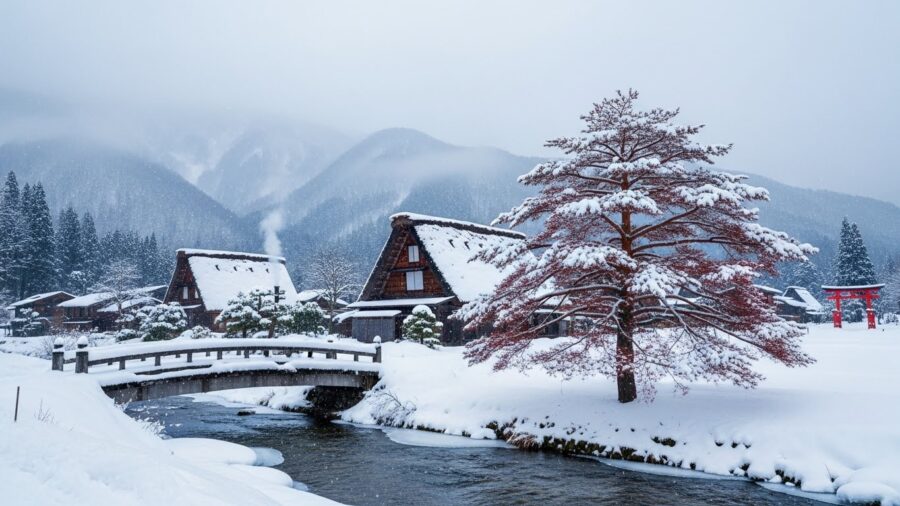
Located in the remote mountains of Gifu Prefecture, the historic village of Shirakawa-go is world-renowned for its traditional gassho-zukuri farmhouses. These structures feature steep, thatched roofs designed to resemble hands clasped in prayer, a necessary architectural innovation to withstand the region’s heavy snow accumulation. In winter, the village transforms into a picturesque landscape that looks like a scene from a fairytale. The Shirakawa-go winter illumination events, held on select evenings in January and February, are particularly popular, casting a warm glow over the snow-covered roofs.
Jigokudani Monkey Park
In the snowy valley of the Yokoyu River in Nagano Prefecture, the Jigokudani Monkey Park offers a wildlife spectacle found nowhere else on Earth. Here, wild Japanese macaques, famously known as Snow Monkeys, descend from the steep cliffs and forests to sit in the warm waters of the natural onsen (hot springs). Watching these monkeys groom each other and relax in the steaming water while snow falls around them is a quintessential Japanese winter experience and a favorite subject for photographers.
Kenrokuen Garden in Kanazawa
Kenrokuen in Kanazawa, Ishikawa Prefecture, is considered one of the Three Great Gardens of Japan and offers a distinct beauty in the winter months. The garden is famous for yukitsuri, a technique where ropes are attached in a conical array from the tops of pine trees to lower branches to prevent them from breaking under the weight of wet, heavy snow. This functional yet highly aesthetic feature creates a geometric harmony against the organic white landscape, making Kenrokuen a top destination for appreciating the art of Japanese gardening in winter.
| Destination | Location | Winter Highlight |
|---|---|---|
| Shirakawa-go | Gifu Prefecture | Gassho-zukuri farmhouses & Illumination |
| Jigokudani Monkey Park | Nagano Prefecture | Snow Monkeys bathing in hot springs |
| Kenrokuen Garden | Ishikawa Prefecture | Yukitsuri (Snow hanging ropes) |
Kansai and Surroundings Iconic Temples in Snow
While the northern regions of Hokkaido and Tohoku are synonymous with deep powder snow, the Kansai region offers a more fleeting and poetic winter beauty. In cities like Kyoto and Nara, snow is not an everyday occurrence. However, when the temperature drops and a blanket of white covers the ancient capital, the landscape transforms into a breathtaking scene reminiscent of traditional ink-wash paintings. This phenomenon, often referred to by locals as “Yukigesho” (snow makeup), creates a stark and stunning contrast against the vibrant colors of historic architecture.
For travelers, catching these iconic sites in the snow requires a bit of luck and timing, but the reward is one of the most photogenic experiences in Japan. Unlike the rugged wilderness of the north, the winter scenery here is defined by the serene interplay between nature and centuries-old craftsmanship.
Kinkaku-ji Temple The Golden Pavilion
Kinkaku-ji (The Golden Pavilion) is arguably the most famous sight in Kyoto, but seeing it capped with snow is a rare privilege that tops many photographers’ bucket lists. The temple’s top two floors are completely covered in gold leaf, which shines brilliantly against the pure white snow and the stark winter sky. This dazzling structure is reflected in the Kyoko-chi (Mirror Pond) below, creating a double image of golden radiance amidst the monochrome winter palette.
Because Kyoto’s winters are relatively mild compared to the Japanese Alps, snow at Kinkaku-ji often melts by the afternoon. To witness this spectacle, visitors are advised to arrive early in the morning immediately following a snowfall forecast. The view of the pavilion standing stoically in the freezing air offers a moment of Zen perfection that defines the Japanese aesthetic of beauty.
Kifune Shrine in Kyoto
Located in the mountainous Kibune area north of Kyoto City, Kifune Shrine is a spiritual retreat that feels worlds away from the urban center. While snow is sporadic in the city center, the higher elevation of Kibune means it sees snow more frequently, making it a reliable spot for winter sightseeing in the Kansai region. The shrine is renowned for its stone staircase lined with vermilion lanterns, which create a magical path leading up into the forest.
In winter, the contrast between the vivid red lanterns and the white snow is striking. Kifune Shrine also holds special illumination events known as “Snowy Days Light-up” on select dates during January and February. During these events, the snow-covered steps and shrine grounds are softly lit, creating a mystical and romantic atmosphere. Since the dates depend on weather conditions, it is essential to check the official Kifune Shrine website for the latest updates on illumination schedules.
Comparing Kansai’s Winter Icons
To help you plan your visit to these iconic spots, the table below outlines the key differences in access and the likelihood of encountering snow.
| Feature | Kinkaku-ji (Golden Pavilion) | Kifune Shrine |
|---|---|---|
| Location | Northern Kyoto City (Kita Ward) | Kibune Mountains (Sakyo Ward) |
| Snow Frequency | Low (Rare, melts quickly) | Medium (Higher elevation, snow stays longer) |
| Visual Highlight | Gold leaf contrasting with white snow | Red lanterns illuminating snowy steps |
| Best Time to Visit | Early morning (9:00 AM) right after snowfall | Late afternoon to evening for illumination |
| Official Info | Kinkaku-ji Website | Kifune Shrine Website |
Visiting these locations requires monitoring weather forecasts closely. For the most accurate travel information and real-time updates on conditions in Kyoto, the Kyoto City Official Travel Guide is an invaluable resource. Whether it is the golden reflection on a pond or the glow of lanterns in a snowy forest, the winter temples and shrines of Kansai offer a profound silence and beauty found nowhere else.
Practical Tips for Visiting Recommended Sightseeing Spots
Essential Winter Clothing and Gear
| Item Category | Recommended Items | Notes |
|---|---|---|
| Base Layer | Thermal tops and leggings | Avoid cotton; choose synthetic or wool blends. |
| Outerwear | Down jacket, waterproof shell | Must be water-resistant for heavy snowfall. |
| Footwear | Snow boots, slip-on spikes | Grip is essential for icy streets. |
| Accessories | Gloves, beanie, scarf, ear muffs | Touchscreen gloves are useful for navigation. |
| Miscellaneous | Disposable heat packs (*kairo*) | Available at any convenience store; stick them to your clothes (not skin). |
Safety and Etiquette in Snowy Areas
Conclusion
Exploring Japan during the winter months offers a perspective of the country that is vastly different from the cherry blossoms of spring or the vibrant festivals of summer. From the rugged, drift-ice-covered coasts of Hokkaido to the silent, snow-dusted temples of Kyoto, the winter season transforms the landscape into a breathtaking monochrome masterpiece. Whether you are seeking the thrill of world-class powder snow or the serene atmosphere of a secluded onsen town, Japan’s winter scenery provides an unforgettable travel experience.
Throughout this guide, we have traversed the most iconic winter destinations. We started in the north, where the Sapporo Snow Festival and the romantic Otaru Snow Light Path showcase the artistic side of the cold. Moving down to the Tohoku region, the nostalgic gas lamps of Ginzan Onsen and the majestic Snow Monsters of Zao highlighted the deep cultural connection between the Japanese people and their snowy environment. In the Chubu region, the UNESCO-listed village of Shirakawa-go and the adorable snow monkeys of Jigokudani proved that winter is a time of vibrant life and enduring history. Finally, the rare sight of Kinkaku-ji and Kifune Shrine in the Kansai region reminded us that even the most famous landmarks reveal a new beauty under a blanket of white.
To help you plan your journey, here is a quick summary of the regions and their distinct winter appeals discussed in this article.
| Region | Primary Appeal | Iconic Spots | Best Timing |
|---|---|---|---|
| Hokkaido | Winter Festivals & Nature | Sapporo, Otaru, Abashiri (Drift Ice) | Early February |
| Tohoku | Traditional Onsen & Deep Snow | Ginzan Onsen, Zao Onsen, Ouchi-juku | January to February |
| Chubu | Historic Villages & Alps | Shirakawa-go, Jigokudani, Kenrokuen | January to February |
| Kansai | Temples & Shrines in Snow | Kinkaku-ji, Kifune Shrine | January to February (Snow is sporadic) |
Visiting these spots requires some preparation, particularly regarding attire and transportation, but the reward is well worth the effort. The contrast between the freezing outdoor air and the warmth of Japanese hospitality—omotenashi—creates a cozy and inviting atmosphere that defines winter travel in Japan. Whether you are warming up with a hot pot dish after viewing the Shirakawa-go light-up or soaking in a hot spring while watching the snow fall in Yamagata, the memories made here are unique to this season.
As you finalize your itinerary, remember to check the latest weather forecasts and event schedules, as winter conditions can change rapidly. Embracing the cold is part of the adventure, leading you to scenery that feels like stepping into an ink wash painting. We hope this guide inspires you to bundle up and discover the quiet, magical beauty of Japan in winter.
For more information on travel logistics and current conditions, you can visit the official guide by the Japan National Tourism Organization.