Essential Earthquake Preparedness for Foreigners Living in Japan and Those Planning to Move to Japan
2025年12月11日
For international residents living in Japan and those planning to relocate, the prospect of experiencing a major earthquake can be a significant source of anxiety. While Japan is one of the most seismically active countries in the world, proper preparation is the most effective way to mitigate risk and ensure personal safety. This article provides a comprehensive guide to earthquake preparedness tailored specifically for the foreign community, moving beyond basic awareness to actionable defense strategies. You will gain a clear understanding of the unique Japanese seismic intensity scale known as Shindo, learn how to secure your home against tremors using tension rods and shatterproof film, and discover the essential items required for a practical emergency survival kit, including the “rolling stock” method for food. Furthermore, we will explain how to access vital information in English through resources like the Safety tips app, NHK World Japan, and the J-Alert system. By mastering these safety measures and evacuation procedures, you can navigate life in Japan with confidence and peace of mind, fully prepared to respond calmly when a disaster occurs.
目次
Understanding the Earthquake Risk for Those Planning to Move to Japan
Frequency of Earthquakes in the Japanese Archipelago
Japan is one of the most seismically active countries in the world, located along the “Pacific Ring of Fire” where four distinct tectonic plates meet: the Pacific, Philippine Sea, Eurasian, and North American plates. This unique geological position means that the Japanese archipelago experiences frequent tremors. In fact, it is estimated that Japan accounts for approximately 20% of the world’s earthquakes with a magnitude of 6.0 or greater. While many of these are minor tremors that go unnoticed, the country records around 1,500 perceptible earthquakes every year. For foreign residents, understanding that earthquakes are a “when” rather than an “if” scenario is the first step in effective preparedness.
The Difference Between Magnitude and the Shindo Seismic Intensity Scale
One of the most confusing aspects for new residents is the difference between “Magnitude” and the Japanese “Shindo” (seismic intensity) scale. While Magnitude measures the total energy released at the earthquake’s source (epicenter), Shindo measures the degree of shaking felt at a specific location on the surface.
Japan uses the JMA (Japan Meteorological Agency) Seismic Intensity Scale, which ranges from 0 to 7. Unlike the Magnitude scale, which is a single number for the entire quake, the Shindo level varies by region. For example, a high-magnitude earthquake offshore might result in a low Shindo level in Tokyo if the epicenter is far away. Conversely, a moderate magnitude quake directly underneath a city can cause a high Shindo level and significant damage.
| Shindo Level | Perceived Intensity & Effects |
|---|---|
| Shindo 1–2 | Felt slightly by some people; hanging objects may sway. |
| Shindo 3–4 | Felt by most; dishes rattle, and unstable ornaments may fall. Walking can be unsteady at level 4. |
| Shindo 5 (Lower/Upper) | Hard to walk; heavy furniture may slide or topple. Unreinforced walls may collapse. |
| Shindo 6 (Lower/Upper) | Impossible to stand; large furniture falls; doors may become jammed. Significant structural damage is likely. |
| Shindo 7 | The highest level. People may be thrown by the shaking; most buildings sustain severe damage. |
For detailed information on the scale, you can refer to the Japan Meteorological Agency (JMA) website.
Checking Hazard Maps Before Renting an Apartment
Before signing a lease or buying a property, it is crucial to check the local “Hazard Map” (Hazado Mappu). These maps are issued by municipal governments and identify areas at high risk for specific disasters, such as liquefaction, tsunamis, landslides, and flooding.
In Japan, real estate agents are legally required to explain these risks during the contract process, but proactive checking is recommended. You can access the MLIT Hazard Map Portal Site to view risk information for any location in Japan. Paying attention to the ground solidity and elevation can significantly impact your safety during a major seismic event.
Home Safety Measures for Foreigners Living in Japan
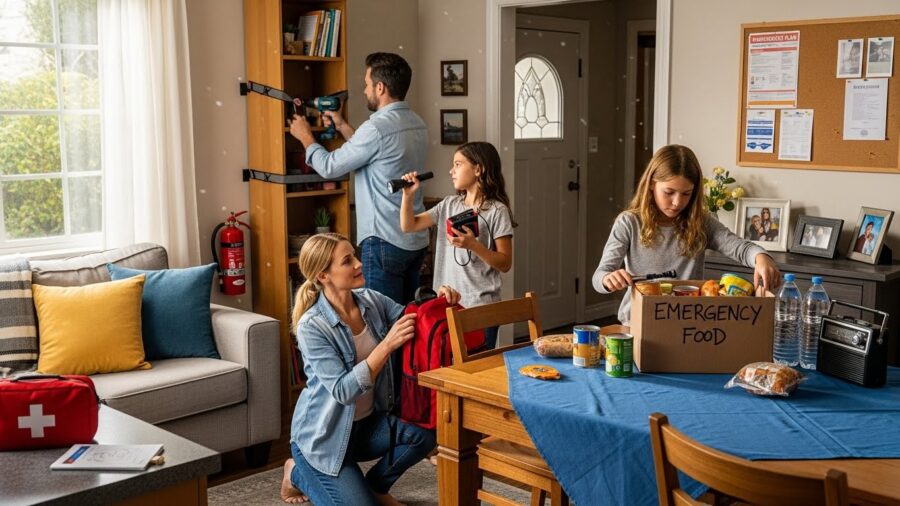
For international residents in Japan, preparing your living space is the most critical step in earthquake disaster prevention. Statistics from major earthquakes, such as the Great Hanshin-Awaji Earthquake, indicate that a significant percentage of injuries and fatalities are caused by being crushed by falling furniture or injured by scattered glass. Unlike in some other countries, Japanese homes are often compact, meaning tall furniture can easily block escape routes if it topples. Implementing the following safety measures can significantly increase your chances of survival and reduce the risk of injury.
Securing Tall Furniture with Tension Rods and L-Brackets
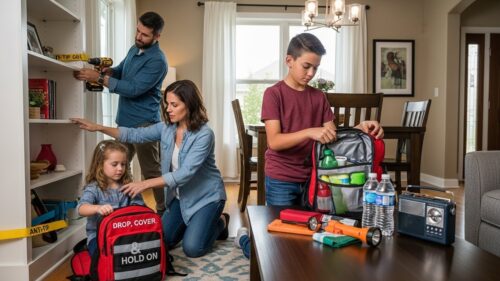
Preventing furniture from tipping over is the first line of defense. While screwing L-brackets (metal fittings) into the wall studs is the most effective method, many foreigners living in Japan rent apartments where drilling holes is prohibited. in such cases, non-invasive tools are essential.
A popular solution in Japan is the “Tension Rod” (known locally as tsuppari-bo). These extendable poles are placed between the top of the furniture and the ceiling to hold the item in place. For maximum effectiveness, they should be installed at the rear of the furniture, close to the wall, and used in combination with stabilization mats placed under the front legs of the furniture.
| Method | Effectiveness | Installation Note | Best For |
|---|---|---|---|
| L-Brackets (Screws) | High | Requires drilling into wall studs. | Homeowners; heavy furniture like bookshelves. |
| Tension Rods (Tsuppari-bo) | Medium | No tools required; relies on ceiling strength. | Renters; tall wardrobes and cupboards. |
| Stabilization Mats/Stoppers | Low-Medium | Placed under front legs to tilt furniture back. | Renters; used in combination with rods. |
| Strap/Chain Fasteners | Medium-High | Anchors furniture to wall studs. | Refrigerators and electronics. |
It is highly recommended to visit a local home center or “100-yen shop” to find these specialized disaster prevention goods. Ensure that the ceiling is reinforced enough to withstand the pressure of tension rods before installation.
Applying Shatterproof Film to Windows and Glass Cabinets
During a strong tremor, window panes and glass doors on cupboards can shatter violently. Since it is customary to not wear shoes inside Japanese homes, walking across a floor covered in invisible shards becomes a major hazard, potentially delaying evacuation or causing severe foot injuries.
Applying shatterproof film to all glass surfaces is a proactive measure. This transparent film keeps the glass fragments adhered together even if the pane breaks. If applying film to all windows is difficult, prioritize the bedroom and the evacuation path leading to the front door. Additionally, always keep a pair of thick-soled slippers or shoes near your bed to protect your feet in an emergency.
For more detailed guidance on indoor safety, you can refer to the Tokyo Fire Department’s guide on furniture safety.
Arranging Furniture to Secure Evacuation Routes
The layout of your room determines whether you can escape quickly. Even if furniture is secured, drawers may fly open, or contents may spill out, blocking narrow corridors. When arranging your living space, assume that furniture could fall or slide.
- Keep Doorways Clear: Do not place tall furniture near the entrance to the room or the main apartment door. If a cabinet falls over, it could wedge the door shut, trapping you inside.
- Create a Safe Sleeping Zone: Position your bed or futon so that no tall furniture can fall on you while you sleep. If space is limited, ensure that the furniture would fall away from the bed rather than onto it.
- Secure Electronics: Televisions and microwaves can become projectiles. Use adhesive gel mats or strap fasteners to secure them to their stands.
By visualizing the “fall radius” of every object in your home, you can arrange your furniture to preserve a clear path to safety. This preparation is vital for anyone planning to live in Japan, where seismic activity is a part of daily life.
Building an Emergency Survival Kit for Foreign Residents
When living in Japan, preparing an emergency survival kit is one of the most critical steps to ensure your safety during a major earthquake. Disaster preparedness experts in Japan recommend preparing two types of supplies: a “Grab-and-Go” bag (Level 1) for immediate evacuation and a “Stockpile” (Level 2) for sheltering in place. Having these items ready can significantly reduce panic and help you survive the first 72 hours, which is considered the critical window for rescue operations.
Essential Items for Your Grab-and-Go Backpack
A Grab-and-Go backpack, known as a hijyo-mochidashi-bukuro in Japan, should be kept near your entrance or bed. It must be light enough to carry while running but contain items essential for survival at an evacuation center. Focus on hygiene and information gathering, as evacuation centers may lack immediate supplies.
| Category | Essential Items |
|---|---|
| Hydration & Food | 2-3 bottles of water (500ml), high-calorie energy bars, glucose tablets. |
| Safety & Tools | Flashlight, portable radio (hand-crank type is best), extra batteries, work gloves, helmet or safety hood, whistle. |
| Hygiene & Health | Portable toilet bags, wet wipes, masks, first aid kit, prescription medicines, toothbrush, sanitary products. |
| Clothing | Raincoat, thermal blanket (aluminum sheet), sturdy shoes, change of underwear. |
Stockpiling Water and Food Using the Rolling Stock Method
If your home is safe after a quake, you may need to shelter in place for several days. Infrastructure like water, electricity, and gas may be cut off. The “Rolling Stock” method is a practical way to manage food reserves without buying expensive emergency rations. This involves buying a little more of the food you eat regularly, consuming the older items first, and replenishing them immediately.
Aim to stockpile enough food and water for at least three days to one week. The recommended amount of water is 3 liters per person per day. Useful items for your rolling stock include:
- Retort pouches (curry, pasta sauce) and canned foods.
- Freeze-dried foods (rice, soup) that only require water.
- A portable cassette gas stove and spare gas canisters (crucial for boiling water if gas stops).
Important Documents like Passports and Residence Cards
For foreign residents, identification documents are vital for proving your legal status and receiving public assistance after a disaster. Ensure you have the following items in a waterproof pouch or ziplock bag within your emergency kit:
- Residence Card (Zairyu Card): Your primary ID in Japan.
- Passport: A copy is acceptable if you keep the original in a safe, accessible place, but having the original is safer if you must evacuate permanently.
- Health Insurance Card: Essential for medical treatment.
- My Number Card: Useful for administrative procedures.
- Okusuri Techo (Medication Notebook): Helps doctors understand your medical history if you lose your medicine.
Cash and Coins for Public Phones During Power Outages
Japan is becoming more cashless, but during a major disaster, power outages can render credit cards and smartphone payments (like Suica or PayPay) useless. ATMs may also stop working. It is essential to keep a stash of physical cash in your emergency kit.
Pay special attention to coins. 10-yen and 100-yen coins are necessary to use public phones (green or grey payphones), which often remain operational during blackouts when mobile networks are down or congested. Public phones are a reliable lifeline for contacting embassies or family members.
For more detailed checklists and disaster prevention guides, refer to the Tokyo Metropolitan Government Disaster Prevention website.
Information Sources and Apps in English
Obtaining accurate information quickly is crucial during an earthquake. For non-Japanese speakers, relying solely on Japanese media can lead to confusion and anxiety. By preparing reliable English-language information sources and apps in advance, you can ensure you receive critical updates on seismic intensity, tsunami risks, and evacuation instructions immediately after a tremor occurs.
Installing the Safety tips App for Disaster Alerts
The “Safety tips” app is a free application developed under the supervision of the Japan Tourism Agency specifically for foreign tourists and residents in Japan. It is one of the most essential tools to install on your smartphone upon arrival.
This app provides push notifications for Earthquake Early Warnings, Tsunami Warnings, and other weather-related alerts in multiple languages, including English, Chinese, and Korean. Unlike some domestic apps that require Japanese literacy, Safety tips is designed with a user-friendly interface for international users. It also includes a communication card feature that allows you to point to questions and phrases to communicate with Japanese people during an emergency, bridging the language gap when it matters most.
You can download the app and find more details on the official Japan National Tourism Organization (JNTO) website.
Following NHK World Japan for Real-Time Updates
NHK (Japan Broadcasting Corporation) is Japan’s public broadcaster and the most reliable source of information during natural disasters. NHK World-Japan is its international service, providing news and programs in English and other languages.
In the event of a major earthquake, NHK World-Japan switches to breaking news coverage, offering live updates on the epicenter, magnitude, and tsunami advisories. It is highly recommended to install the NHK World-Japan app or bookmark their website. The app allows you to watch the live TV stream and receive push notifications for breaking news, ensuring you have access to visual information and expert commentary even if you are away from a television set.
Understanding J-Alert Warnings on Your Mobile Phone
J-Alert (National Instant Warning System) is a system used by the Japanese government to transmit emergency information instantly to residents. When a massive earthquake is predicted or a tsunami is imminent, a distinctive and loud alarm sound will play on mobile phones in the affected area, even if the device is set to silent mode.
While this system is critical for immediate safety, the text displayed on the screen may sometimes be in Japanese depending on your mobile carrier and device settings. Therefore, it is vital to understand that this specific alarm sound signifies immediate danger. Do not be confused by the noise; instead, prioritize protecting your head and moving to a safe location. Once the shaking stops, use apps like Safety tips or NHK World-Japan to confirm the details of the alert in English.
| Source Name | Type | Key Features |
|---|---|---|
| Safety tips | Mobile App | Push notifications for earthquakes and tsunamis in multiple languages; communication cards. |
| NHK World-Japan | News Media / App | 24-hour English live streaming, breaking news alerts, and disaster commentary. |
| J-Alert | Government System | Instant loud alarm on mobile phones for immediate threats; often integrated with carrier networks. |
Action Plan When an Earthquake Occurs
Panic is the greatest danger during a seismic event. Knowing exactly what steps to take when the ground starts shaking can significantly increase your chances of survival. This section outlines immediate safety actions, evacuation protocols, and how to confirm the safety of your loved ones.
Immediate Safety Actions Indoors and Outdoors
Your reaction should depend on your location. The priority is always to protect your head and stay away from falling objects. Do not rush outside while the shaking is violent, as falling glass and debris pose a major risk.
| Location | Recommended Action |
|---|---|
| Indoors | Follow the “Drop, Cover, and Hold On” protocol. Get under a sturdy desk or table. Stay away from windows, glass cabinets, and tall furniture. |
| Outdoors | Move to an open area away from concrete block walls, glass buildings, and vending machines that could topple over. |
| Elevators | Press the buttons for every floor and get off at the first stop. If trapped, use the emergency call button to contact the control center. |
| On Public Transport | Hold on tight to handrails or straps. Follow the instructions of the train or bus staff and do not force doors open. |
Evacuation Procedures and Finding Designated Shelters
Evacuation is not always necessary if your building is undamaged and there is no risk of fire or tsunami. However, if you are in a coastal area and feel a strong tremor, move to high ground immediately to escape potential tsunamis. Do not wait for an official warning.
It is important to understand the two types of evacuation locations in Japan:
- Designated Emergency Evacuation Site (Kinkyu Hinan Basho): Open spaces like parks or school grounds used to escape immediate dangers such as fires or spreading debris.
- Designated Shelter (Hinanjo): Facilities like school gymnasiums or community centers where residents can stay temporarily if their homes are uninhabitable.
Confirm these locations on your municipality’s hazard map or by using the Safety tips app provided by the Japan Tourism Agency.
Using the Disaster Message Board Web 171
During a major disaster, voice calls often fail due to network congestion. Data networks tend to be more resilient. The Disaster Emergency Message Dial (171) and the web-based version, Web 171, are critical tools provided by NTT for safety confirmation.
Using Web 171, you can register a text message using your phone number as a key. Family members and friends, including those overseas, can view your message by entering your phone number on the site. It is advisable to decide beforehand which phone number your family will use as the primary key for communication.
Conclusion
Living in Japan offers a unique and enriching experience, but it requires accepting and preparing for the natural reality of the archipelago: earthquakes. While the frequency of seismic activity can be daunting for those new to the country, proper preparation is the most effective way to mitigate fear and ensure safety. By shifting your mindset from worrying about “if” an earthquake will happen to preparing for “when” it occurs, you can navigate daily life in Japan with confidence and peace of mind.
Throughout this guide, we have explored the critical steps to safeguard yourself and your family. Securing tall furniture with tension rods and L-brackets, applying shatterproof film to windows, and ensuring your evacuation routes are clear are foundational home safety measures that should be completed immediately upon moving in. Furthermore, adopting the “Rolling Stock” method allows you to maintain a constant supply of food and water without the stress of managing a separate emergency hoard. Remember, your emergency kit is not just about survival gear; it must include copies of essential documents like your residence card and passport, as well as cash for when electronic payments fail.
Summary of Critical Actions
To help you finalize your earthquake preparedness plan, use the checklist below to verify that you have covered the essential safety measures discussed in this article.
| Category | Key Action Items | Primary Objective |
|---|---|---|
| Home Safety | Install tension rods, L-brackets, and shatterproof glass film. | Prevent injuries from falling furniture and flying glass. |
| Supplies | Prepare a “Grab-and-Go” bag and 3-7 days of water/food (Rolling Stock). | Ensure survival during power outages and evacuation. |
| Information | Install the Safety tips app and follow NHK World-Japan. | Receive real-time J-Alerts and updates in English. |
| Communication | Confirm designated shelters and discuss meeting points with family. | Reunite quickly if separated during a disaster. |
Embracing Life in Japan Safely
Disaster preparedness is not a one-time task but an ongoing lifestyle adjustment. We strongly recommend regularly checking the expiration dates of your stockpiled food and ensuring your mobile devices are set up to receive official disaster information. By integrating these habits into your routine, you transform potential panic into calculated action. Japan has robust infrastructure and detailed disaster management systems, but your personal preparedness is the final piece of the safety puzzle. Stay informed, stay prepared, and enjoy your time in Japan knowing you are ready for whatever nature brings.