Tokyo Travel Guide: Introduction to Old Wooden Architecture at Senso-ji and Asakusa Shrine
2026年01月28日
Explore the historic wooden architecture of Senso-ji Temple and Asakusa Shrine in this comprehensive guide. Readers will understand the ingenuity of Edo-period craftsmanship, from the earthquake-resistant Five-Story Pagoda to the unique Gongen-zukuri style, gaining insight into the structural resilience that preserves Tokyo’s cultural heritage.
Historical Significance of Asakusa in Tokyo
Asakusa stands as the enduring heart of Tokyo’s “Shitamachi” (low city), offering a profound contrast to the neon-lit skyscrapers of Shinjuku and Shibuya. While modern Tokyo is often defined by its futuristic skyline, Asakusa preserves the atmosphere of a bygone era, anchored by the city’s oldest temple, Senso-ji. The district’s historical significance lies not only in its religious heritage but also in its role as the cultural and entertainment capital of the Edo period. Understanding this context is essential before exploring the specific architectural marvels of the temple and the adjacent Asakusa Shrine.
Origins as a Temple Town (Monzen-machi)
The history of Asakusa is inextricably linked to the Sumida River. According to legend, in the year 628, two fishermen brothers, Hinokuma Hamanari and Takenari, found a statue of the Bodhisattva Kannon in their fishing net. This discovery led to the establishment of Senso-ji, marking the birth of Asakusa as a religious center. Over the centuries, the area developed as a classic Monzen-machi, or temple town, where commerce and residence flourished around the sacred grounds.
During the Edo period (1603–1867), the district’s importance skyrocketed when Tokugawa Ieyasu, the first shogun, designated Senso-ji as a tutelary temple for the Tokugawa clan. This patronage ensured a steady influx of pilgrims and visitors, transforming the approach to the temple into a bustling commercial artery known today as Nakamise-dori.
The Cultural Epicenter of Edo
Beyond its religious functions, Asakusa evolved into the primary entertainment district of Edo. The area north of the temple, known as “Okuyama,” became a playground for the common people, teeming with street performers, acrobats, and tea houses. This vibrant atmosphere fostered the growth of Kabuki theaters and ukiyo-e (woodblock print) culture, cementing Asakusa’s reputation as a hub of creativity and leisure.
The concentration of wooden architecture in this area reflects the aesthetic and practical requirements of the time. However, the density of these wooden structures also made the district vulnerable to fire, a recurring theme in Tokyo’s architectural history that influenced the rebuilding techniques discussed in later sections.
Timeline of Asakusa’s Historical Evolution
The following table outlines key eras in Asakusa’s development, highlighting events that shaped the landscape where these historic wooden structures stand today.
| Era | Approximate Year | Key Historical Event | Impact on Asakusa |
|---|---|---|---|
| Asuka Period | 628 AD | Discovery of the Kannon statue | Foundation of Senso-ji and the settlement of Asakusa. |
| Edo Period | Early 17th Century | Designation as Tutelary Temple | Massive expansion of temple grounds and establishment of the entertainment district. |
| Meiji Period | 1873 | Establishment of Asakusa Park | Designated as Tokyo’s first public park, modernizing the surrounding area while preserving the religious core. |
| Showa Period | 1945 | Great Tokyo Air Raids | Destruction of the main hall and gates, leading to the post-war reconstruction efforts that blended traditional design with modern resilience. |
Resilience and Reconstruction
The wooden architecture of Asakusa is a testament to resilience. The district has been leveled multiple times, most notably by the Great Kanto Earthquake of 1923 and the air raids of World War II. While many original structures were lost, the layout and the architectural style were painstakingly restored. The survival of the Senso-ji Temple complex and the adjacent Asakusa Shrine—which miraculously survived the wartime bombings—provides a rare physical link to the Edo period. This duality of destruction and faithful reconstruction defines the current architectural landscape, where Edo-era designs coexist with modern structural engineering.
Today, Asakusa remains a vital guardian of Tokyo’s traditional culture. It serves as the venue for the Sanja Matsuri, one of Tokyo’s largest festivals, which celebrates the three founders of the temple. For visitors, the district offers a tangible connection to the history of Tokyo, setting the stage for a deeper appreciation of the intricate woodwork and design found in its iconic buildings.
Exploring the Wooden Architecture of Senso-ji Temple
Senso-ji Temple is not only Tokyo’s oldest temple but also a premier example of Japanese Buddhist architecture. While many of the structures have been rebuilt following the devastation of World War II, they faithfully adhere to the architectural styles of the Edo period, utilizing traditional carpentry aesthetics even when modern materials like reinforced concrete are employed for structural integrity. The complex represents a harmony between the spiritual devotion of the 7th century and the architectural grandeur of the Tokugawa shogunate.
The History and Origins of Senso-ji
The origins of Senso-ji date back to 628 AD, when two brothers, Hinokuma Hamanari and Takenari, fished a golden statue of the Bodhisattva Kannon out of the Sumida River. Recognizing the sanctity of the statue, the village headman, Haji no Nakatomo, remodeled his own home into a small temple to enshrine it. This event marks the beginning of Buddhism in the region.
Throughout its history, the temple has enjoyed the patronage of military commanders and shoguns, particularly during the Edo period (1603–1867) under the Tokugawa clan. This patronage allowed for the construction of magnificent wooden buildings. Although the Great Kanto Earthquake of 1923 and the air raids of 1945 destroyed much of the complex, the subsequent reconstruction efforts were driven by a desire to preserve the historic townscape of Asakusa, resulting in the majestic structures seen today.
Kaminarimon Gate and Its Structural Design
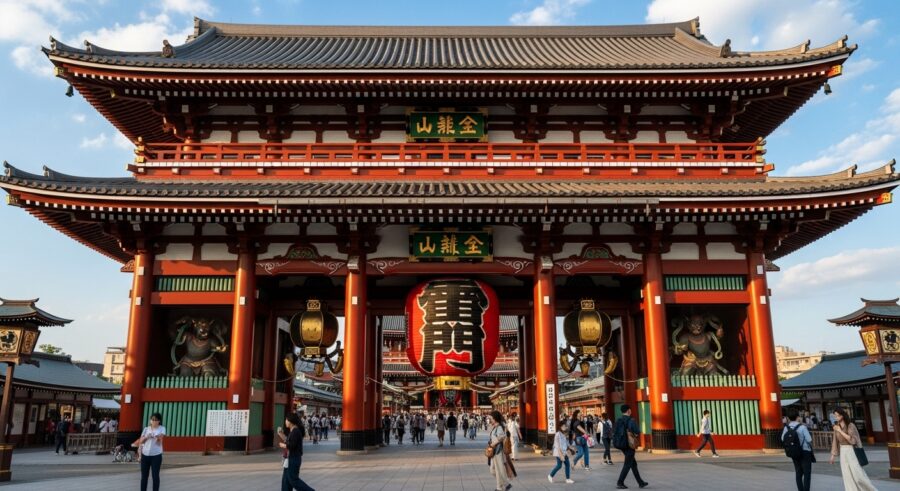
The Kaminarimon (Thunder Gate), officially known as Furaijinmon, serves as the outer face of Senso-ji. The current structure, rebuilt in 1960 through a donation by Konosuke Matsushita (founder of Panasonic), follows the traditional kirizuma (gabled) roof style. While the pillars and beams are constructed with modern durability in mind, the design replicates the vermilion-lacquered wooden gates of the past.
A defining feature of the gate is the massive red lantern, which weighs approximately 700 kilograms. Flanking the lantern are the statues of Fujin (Wind God) and Raijin (Thunder God), housed in open bays that showcase the intricate latticework typical of Japanese temple gates. Under the base of the lantern, visitors can observe a detailed wooden carving of a dragon, symbolizing the water deity associated with the temple.
The Five Story Pagoda and Earthquake Resistance
The Five-Story Pagoda (Goju-no-to) is a striking vertical element of the temple grounds, standing roughly 53 meters tall. The original pagoda was built in 942, and the structure destroyed in 1945 was a National Treasure built by Tokugawa Iemitsu. The current pagoda, completed in 1973, is built of steel-reinforced concrete but maintains the exterior appearance of a classic wooden pagoda with a tile roof.
Despite the modern materials, the pagoda incorporates a traditional seismic design principle known as shinbashira (central pillar). In traditional wooden pagodas, a thick central pillar runs from the base to the finial at the top but is not structurally connected to the surrounding floors. This allows the pillar to sway independently during an earthquake, acting as a mass damper to absorb vibrational energy and prevent collapse. This ancient engineering technique is so effective that it has influenced the design of modern skyscrapers, including the Tokyo Skytree.
Hozomon Gate The Treasure House
Passing through the Nakamise shopping street leads to the Hozomon (Treasure-House Gate). This massive inner gate is a two-story structure featuring an irimoya (hip-and-gable) style roof. Rebuilt in 1964, it serves a dual purpose: acting as a guardian gate and a storage facility.
The upper story of the Hozomon houses the temple’s treasures, including a copy of the Lotus Sutra designated as a National Treasure. Architecturally, the gate is noted for its three large lantern passageways and the gigantic waraji (straw sandals) hanging on the rear side. These sandals, woven by villagers from Yamagata Prefecture, are meant to symbolize the strength of the Nio guardian statues enshrined within the gate, suggesting that anyone who wears such sandals would be powerful enough to ward off evil spirits.
The Main Hall Kannondo and Its Grandeur
The Main Hall (Hondo or Kannondo) is the centerpiece of Senso-ji. The previous wooden structure, built by the third Shogun Tokugawa Iemitsu in 1649 and designated a National Treasure, was lost to fire in 1945. The current hall was reconstructed in 1958 using reinforced concrete, yet it meticulously preserves the architectural style of the early Edo period.
The hall features a steep, copper-tiled roof that curves elegantly outward, a hallmark of traditional Japanese temple design. The complex bracket systems (tokyo) supporting the eaves are painted in vibrant vermilion, contrasting with the white walls. Inside, the ceiling is adorned with exquisite paintings: “Dragon” by Ryushi Kawabata and “Celestial Maiden” by Insho Domoto. The inner sanctum, or naijin, houses the hidden statue of Kannon and is separated from the outer public area (gejin) by wire screens, maintaining the spatial hierarchy found in ancient wooden temples.
Nitenmon Gate An Original Edo Period Structure
While many of Senso-ji’s main buildings are post-war reconstructions, the Nitenmon Gate stands as a rare survivor and a genuine example of Edo-period wooden architecture. Built in 1618, it was originally the gate for the Toshogu Shrine (dedicated to Tokugawa Ieyasu) within the Senso-ji precincts. It survived the air raids of World War II and is designated an Important Cultural Property by the Japanese government.
The Nitenmon is constructed in the yatsu-ashi-mon (eight-legged gate) style, characterized by four main pillars and eight supporting pillars. The woodwork displays the transition of architectural styles from the Azuchi-Momoyama period to the early Edo period, featuring robust timber framing and ornate carvings. Unlike the vermilion of the main gates, the Nitenmon has a more weathered, historical patina, offering visitors a glimpse into the authentic texture of 17th-century carpentry.
| Structure | Current Construction Date | Architectural Style / Key Feature | Significance |
|---|---|---|---|
| Kaminarimon | 1960 | Kirizuma roof; Giant Lantern | Symbol of Asakusa |
| Five-Story Pagoda | 1973 | Shinbashira (Central Pillar) | Seismic damping technology |
| Main Hall (Hondo) | 1958 | Irimoya roof; Ceiling paintings | Houses the Kannon statue |
| Nitenmon Gate | 1618 | Yatsu-ashi-mon (Eight-legged gate) | Important Cultural Property (Original Wood) |
For more detailed information on the temple’s history and visiting hours, you can refer to the Senso-ji Temple Official Website.
Discovering the Old Architecture of Asakusa Shrine
While the imposing red lantern of the Kaminarimon and the towering Five-Story Pagoda of Senso-ji often dominate the skyline, the adjacent Asakusa Shrine (Asakusa-jinja) stands as a testament to the resilience and intricacy of Edo-period wooden architecture. Also known affectionately by locals as “Sanja-sama” (Shrine of the Three Gods), this structure offers a rare glimpse into the genuine craftsmanship of the mid-17th century. Unlike the main buildings of Senso-ji, which were reconstructed using ferro-concrete after World War II, the Asakusa Shrine complex preserves its original wooden structure, making it one of Tokyo’s most significant existing cultural properties.
The Unique Gongen Zukuri Style
The architectural layout of Asakusa Shrine is a classic example of the Gongen-zukuri style. This sophisticated design is characterized by a complex roof structure that connects the main sanctuary and the worship hall. Commissioned by Tokugawa Iemitsu, the third Shogun of the Tokugawa dynasty, the shrine was completed in 1649. The style is famously associated with the lavish Toshogu Shrine in Nikko, reflecting the power and aesthetic preferences of the Tokugawa shogunate.
In the Gongen-zukuri layout found here, three distinct sections are linked to form a single H-shaped building complex:
- Honden (Main Hall): The sacred innermost chamber where the deities are enshrined.
- Haiden (Worship Hall): The front hall where visitors offer prayers.
- Heiden (Offering Hall): A stone-paved corridor (Ishinomoma) that connects the Honden and Haiden.
This structural unity allows for a fluid interior space and a majestic exterior profile, distinct from the simpler, detached structures seen in earlier shrine architecture.
Survival of the Shrine Through History
One of the most remarkable aspects of Asakusa Shrine is its survival against the catastrophic events that leveled much of Tokyo over the centuries. As a wooden structure in a dense city prone to fires and earthquakes, its existence today is often described as miraculous. Designated as an Important Cultural Property by the Japanese government, it serves as a genuine historical artifact rather than a modern reproduction.
The following table outlines the major historical events that Asakusa Shrine withstood, contrasting its fate with the surrounding area:
| Year | Historical Event | Impact on Asakusa Shrine |
|---|---|---|
| 1649 | Construction by Tokugawa Iemitsu | Completed in the Gongen-zukuri style; remains the current structure. |
| 1923 | Great Kanto Earthquake | Withstood the intense tremors and ensuing fires that destroyed much of downtown Tokyo. |
| 1945 | Great Tokyo Air Raids (WWII) | Miraculously avoided direct hits and fire spread, while the adjacent Senso-ji Main Hall was destroyed. |
| 1951 | Cultural Designation | Officially designated as an Important Cultural Property of Japan. |
This resilience allows visitors to touch and see the same wooden pillars and joinery that were put in place over 370 years ago, providing a tangible link to the Edo period that is rare in modern Tokyo.
Intricate Carvings and Painted Decorations
The visual appeal of Asakusa Shrine lies in its detailed ornamentation, which contrasts with the often unadorned simplicity of Shinto architecture found elsewhere. Reflecting the early Edo period’s transition toward more decorative styles, the shrine features polychrome paintings and elaborate wood carvings. These decorations have been carefully maintained and restored to preserve their vibrancy.
Visitors examining the exterior will notice a variety of mythical beasts and auspicious motifs carved into the transoms and pillars. Key artistic elements include:
- Mythical Creatures: Detailed carvings of dragons, phoenixes, and kirin (mythical hooved chimeras) protect the structure.
- Celestial Maidens: Depictions of tennyo (heavenly maidens) and karyobinga (celestial beings with a human head and bird’s torso) adorn the upper sections, symbolizing the Buddhist influence that was intertwined with Shintoism during the Edo period (Shinbutsu-shugo).
- The Three Nets: Unique emblems representing the three fishermen brothers who founded the temple are incorporated into the design, honoring the shrine’s specific mythology.
For those interested in a deeper dive into the shrine’s history and its architectural specifics, the Asakusa Shrine Official Website provides extensive background information. Additionally, the broader context of the area’s cultural heritage can be explored through the Go Tokyo Official Travel Guide.
Key Differences Between Temple and Shrine Architecture
While Senso-ji Temple and Asakusa Shrine stand adjacent to one another, representing centuries of harmonious coexistence between Buddhism and Shinto, they exhibit distinct architectural features rooted in their respective religious traditions. Understanding these visual and structural differences enhances the experience of exploring Asakusa’s historical landscape.
Religious Roots and Architectural Philosophy
The fundamental difference lies in the religion they house. Senso-ji is a Buddhist temple, dedicated to the Bodhisattva Kannon, and its architecture reflects styles imported from continental Asia (China and Korea) adapted over centuries in Japan. Buddhist architecture often focuses on grandeur, intricate joinery, and spaces designed for the veneration of statues.
Asakusa Shrine (Sanja-sama) is a Shinto shrine, indigenous to Japan. Shinto architecture traditionally prioritizes harmony with nature, often utilizing natural timber and simpler lines, although the Gongen-zukuri style seen at Asakusa Shrine represents a more ornate evolution from the Edo period.
The Gateways: Sanmon vs. Torii
The most immediate visual distinction for visitors is the entrance gate.
- Torii Gates (Shrine): The entrance to Asakusa Shrine is marked by a large stone Torii. This iconic structure, consisting of two upright pillars and two crossbars, symbolizes the transition from the profane world to the sacred space of the Kami (spirits). Unlike temple gates, Torii usually do not have doors, roofs, or walls.
- Sanmon Gates (Temple): Senso-ji is accessed via massive, roofed gates such as the Kaminarimon (Thunder Gate) and the Hozomon. These gates are complex wooden structures housing guardian statues and often serve as storage (such as the sutra storage in Hozomon). They feature heavy tile roofs and intricate bracketing systems characteristic of Buddhist architecture.
Guardians of the Sacred Space
Flanking the entrances of both sites are guardian figures, but their forms differ significantly.
At Senso-ji, the gates are guarded by the Nio (Benevolent Kings), muscular and fierce warriors representing Alpha and Omega, who ward off evil spirits. You will also see the massive Chochin (lanterns) which are a prominent feature of temple gates.
At Asakusa Shrine, the entrance is guarded by Komainu (lion-dogs). These stone statues typically come in pairs: one with an open mouth (articulating “a”) and one with a closed mouth (articulating “un”), symbolizing the beginning and end of all things. Unlike the Nio, which are housed inside the gate structure, Komainu usually sit outdoors on stone pedestals.
Structural Layout and Verticality
The presence of a Pagoda is a definitive feature of Buddhist temple complexes. The Five-Story Pagoda at Senso-ji is a reliquary tower derived from the Indian stupa, designed to house remains of the Buddha. Shinto shrines generally do not possess pagodas, as this is a strictly Buddhist architectural form.
Conversely, Shinto architecture is defined by the sanctuary layout. Asakusa Shrine features the Gongen-zukuri style, where the Haiden (worship hall) and Honden (main sanctuary) are connected by a stone-paved corridor called the Ishunoma. This complex roof structure is distinct from the standalone massive halls found in temples like the Kannondo.
Comparison of Architectural Features
The following table summarizes the key visual identifiers to help distinguish between the temple and shrine elements within the Asakusa complex.
| Feature | Senso-ji (Buddhist Temple) | Asakusa Shrine (Shinto Shrine) |
|---|---|---|
| Entrance Gate | Sanmon / Nio-mon Roofed, ornate, houses statues (e.g., Kaminarimon). |
Torii Simple post-and-lintel structure, marks sacred boundary. |
| Guardians | Nio Guardians Muscular human-like warriors inside the gate. |
Komainu Lion-dog stone statues placed outdoors. |
| Main Structure | Hondo / Kannondo Large hall for statues and incense offering. |
Honden & Haiden Sanctuary for Kami, often connected (Gongen-zukuri). |
| Key Vertical Element | Pagoda (Five-Story Pagoda). | None (focus is on the shrine building itself). |
| Worship Style | Silent prayer, burning incense. | Clapping hands (two bows, two claps, one bow). |
For more detailed historical context on these sites, you can visit the official Senso-ji Temple website or the Asakusa Shrine official website.
Conclusion
Asakusa stands as a testament to Tokyo’s resilience and its deep-rooted respect for tradition. While the district is often defined by the iconic red lantern of the Kaminarimon and the bustling Nakamise shopping street, a closer inspection reveals a complex narrative of destruction and rebirth. The architectural landscape of Senso-ji Temple and Asakusa Shrine offers a unique duality: the grand, vermilion structures of the temple serve as modern symbols of hope rebuilt from the ashes of World War II, while the quiet, weathered wood of the shrine and the Nitenmon Gate endure as authentic witnesses to the Edo period.
The Harmony of Reconstructed Symbols and Historical Survivors
For architecture enthusiasts and history buffs, distinguishing between the reconstructed monuments and the original wooden survivors is key to appreciating Asakusa. The Main Hall and Five-Story Pagoda of Senso-ji, though visually faithful to their predecessors, are feats of modern engineering constructed with ferro-concrete to withstand fire and earthquakes. In contrast, Asakusa Shrine and the Nitenmon Gate retain their original timber frames, preserving the carpentry techniques of the 17th century. This coexistence allows visitors to experience both the grandeur of ancient design and the tangible texture of history.
| Structure Name | Status | Construction Year | Architectural Highlight |
|---|---|---|---|
| Senso-ji Main Hall (Kannondo) | Reconstructed | 1958 | Steep roof slope; reinforced concrete imitating traditional wooden joinery. |
| Asakusa Shrine (Sanja-sama) | Original | 1649 | Gongen-zukuri style; intricate polychrome carvings; designated Important Cultural Property. |
| Nitenmon Gate | Original | 1618 | Oldest surviving gate on the grounds; features original Edo-period timber work. |
| Five-Story Pagoda | Reconstructed | 1973 | Steel-frame reinforced concrete; utilizes a modern interpretation of the shinbashira (central pillar) for damping. |
Preserving the Legacy of Edo Craftsmanship
The survival of Asakusa Shrine is particularly significant as it showcases the elaborate Gongen-zukuri style commissioned by Tokugawa Iemitsu. Unlike the simpler, unadorned styles of earlier periods, this architecture features complex rooflines and rich decorative carvings that reflect the peace and prosperity of the early Edo era. The shrine’s ability to escape the devastation of the Great Kanto Earthquake of 1923 and the air raids of 1945 makes it a rare repository of pre-modern Japanese craftsmanship.
Similarly, while the current Senso-ji structures are modern, they honor traditional wisdom. The reconstruction of the Five-Story Pagoda incorporates the ancient principle of the shinbashira—a central pillar that sways independently of the outer frame to absorb seismic energy. This blend of ancient wisdom and modern technology ensures that the cultural legacy of Asakusa continues to inspire future generations.
The Spiritual Unity of Temple and Shrine
Ultimately, the architecture of Asakusa tells the story of Shinbutsu-shugo, the syncretism of Buddhism and Shinto that defined Japanese spiritual life for centuries. The physical proximity of the Buddhist Senso-ji and the Shinto Asakusa Shrine reflects their historical intertwining; the shrine was originally built to honor the three men who founded the temple. Today, this bond is most visibly celebrated during the Sanja Matsuri, where the spirits of the shrine are paraded through the temple grounds, uniting the community in a vibrant display of faith and tradition.
Visitors are encouraged to look beyond the photo opportunities at the Kaminarimon and take the time to observe the details—the blackened wood of the Nitenmon, the colorful mythical beasts carved into the Asakusa Shrine, and the sweeping titanium-tiled roof of the Main Hall. Together, these structures form a complete picture of Tokyo’s architectural heritage, bridging the gap between the Edo period and the modern day.
For more detailed information on visiting hours and seasonal events, please refer to the official websites of these historic sites: